Authored by: A Caring Mom at Infant Tales
Ten weeks is such a lovely milestone. Your baby is still a newbie, but you might observe that your little one can fix eyes with you longer, smile more, kick harder, and make sounds that seem like he’s speaking. When observing 10 Week Baby Milestones, please keep in mind that babies’ milestones don’t immediately occur. Some kids can master a skill earlier than others or take more time to do it even if it is still okay.
I remember keeping a close watch on my baby during the time and being concerned if he made a smile exactly for me, if his head control improved, if babies at this age should be cooing more. Milestone charts can provide support, but sometimes they can be a source of anxiety, so you should learn to use them as useful guides rather than scores week-by-week.
Table of Contents
- What Should a 10-Week-Old Baby Be Doing?
- 10 Week Baby Milestones You May Notice
- Simple Activities for 10 Weeks Old Baby Milestones
- A Simple Five-Minute Play Routine
- Signs Your Baby Needs a Break
- What Your 10-Week-Old Does Not Need to Do Yet
- Sleep and Feeding at 10 Weeks
- What If My Baby Was Born Early?
- When Should You Talk to Your Pediatrician?
- Frequently Asked Questions About 10 Week Baby Milestones
What Should a 10-Week-Old Baby Be Doing?
At 10 weeks, many babies are becoming more alert, social, and interested in the world around them. You may notice your baby smiling when you talk, looking closely at your face, making soft sounds, lifting their head during tummy time, and moving their arms and legs with a little more control.
These changes do not all appear on the same day. One baby may smile and coo often, while another seems more focused on movement. What matters most is gradual progress over time.
For a broader look at early growth, the Cleveland Clinic’s baby development guide explains common milestones and safety tips for the first months.
10 Week Baby Milestones You May Notice
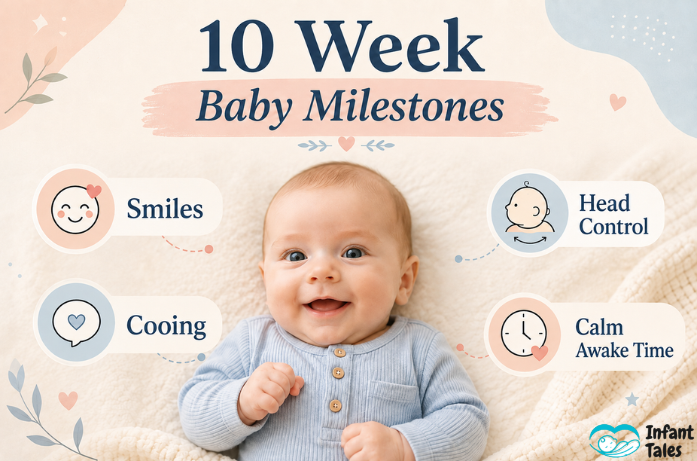
The changes at 10 weeks are often small. Tummy time may last longer, those little fists may open more often, or your baby may stare at you as though your face is the most interesting thing in the room. The CDC developmental milestones guide is also a helpful reference for understanding how early skills usually develop over time.
1. Your Baby May Smile More Socially
One of the sweetest 10 week old baby milestones is the social smile. Unlike sleepy newborn smiles that seem to appear randomly, a social smile may happen because your baby sees your face, hears your voice, or notices you smiling first.
Try talking to your baby during a calm awake moment. Smile gently and wait a few seconds. Babies often need time to process what they see and hear, and that gummy smile back can make a tired day feel much lighter.
2. Your Baby May Recognize Familiar Faces and Voices
By 10 weeks, your baby is becoming more familiar with the people who care for them most. They are learning your face, voice, smell, and the way you hold them. You may notice your baby calming when you pick them up or becoming more alert when they hear you nearby.
Feeding, rocking, talking, and cuddling all help your baby build that sense of familiarity.
3. Cooing and Little Baby Conversations
Around this age, crying may no longer be the only sound you hear. Some babies begin making little “ooo,” “ahh,” or gurgling noises when they are comfortable or excited.
When your baby makes a sound, answer them. Copy the noise, smile, or say something simple, then pause to see whether they respond again. These tiny back-and-forth moments are early communication practice.
4. Head Control Is Slowly Getting Stronger
One of the physical 10 week baby milestones you may notice is stronger head and neck control. During supervised tummy time, your baby may lift their head higher, hold it for longer, or turn from one side to the other with more control.
Their head may still wobble when you hold them upright, especially when they are tired, and that is expected. Continue supporting the head and neck. At this stage, the goal is gradual strength, not perfect control.
5. Arms, Legs, and Hands May Look More Controlled
Newborn movements can look jerky, but by 10 weeks you may notice your baby’s movements becoming smoother. They may kick when excited, stretch their legs, bring their hands toward their face, or open their fingers more often.
You may even catch your baby staring at one hand as though they have discovered something amazing. Purposeful grabbing usually develops later, so do not worry if toys keep slipping away.
6. Longer Calm and Alert Periods
During the first newborn weeks, life can feel like a cycle of feeding, sleeping, crying, and diaper changes. At around 10 weeks, you may begin seeing longer periods when your baby is awake but calm.
Your baby may watch a ceiling fan, look toward a window, stare at your face, or listen while you talk. These calm alert periods are great for learning, but you do not need constant activities. Quietly watching everyday life can be enough stimulation.
Simple Activities for 10 Weeks Old Baby Milestones
Supporting 10 weeks old baby milestones does not require expensive toys or complicated routines. At this age, your face, voice, touch, and a little floor time can provide plenty of stimulation.
Talk face-to-face, make gentle expressions, and pause so your baby has time to react. Offer short tummy-time sessions while your baby is awake and supervised. If they become upset after a minute or two, stop and try again later. The Mayo Clinic’s infant development guide also shares simple information about how babies learn, move, and interact during the early months.
You can also slowly move a simple toy from side to side to see whether your baby follows it with their eyes. Sing familiar songs, read a few pages of a baby book, or simply describe what you are doing around the house.
A Simple Five-Minute Play Routine
Keep play simple: try one or two minutes of tummy time, a little face-to-face talking, then show your baby a toy or high-contrast picture and finish with a short song. Five calm minutes can be plenty, and feeding, cuddling, and diaper changes are learning moments too.
Signs Your Baby Needs a Break
Babies can become overstimulated quickly. Your baby may turn their head away, yawn, become fussy, close their eyes, squirm, or suddenly stop engaging when they have had enough.
It may simply mean their little brain needs a rest. Reduce noise, offer a cuddle, or give them some quiet time.
What Your 10-Week-Old Does Not Need to Do Yet
Milestone articles can make moms feel as though babies should be doing everything at once. At 10 weeks, your baby does not need to roll intentionally, laugh regularly, hold their head perfectly steady, grab toys accurately, or sleep through the night.
Some babies may show early hints of these skills, while others will not. Many of them develop more over the coming weeks.
Sleep and Feeding at 10 Weeks
Sleep can still be unpredictable. Some babies begin sleeping for slightly longer stretches, while others continue waking often. Naps can also change from one day to the next, so try not to compare your baby’s routine with another family’s.
Feeding can be just as changeable because babies are growing quickly. Your baby may suddenly seem hungrier or want to feed more often for a while. Look at overall growth, wet diapers, feeding cues, and your pediatrician’s advice rather than comparing exact ounces or feeding times.
For sleep, continue placing your baby on their back on a firm, flat sleep surface without loose pillows, blankets, or toys.
What If My Baby Was Born Early?
If your baby was born premature, milestone timing may look different. Healthcare professionals often use corrected age for babies who arrived several weeks before their due date.
For example, a baby who is 10 weeks old but was born six weeks early may be compared developmentally with a younger baby. If you are unsure which age to use, ask your pediatrician.
When Should You Talk to Your Pediatrician?
Most milestone differences are part of normal development, but it is always okay to ask questions. Mention it to your pediatrician if your baby does not seem to respond to sounds, rarely looks toward faces, seems unusually floppy or stiff, has ongoing feeding difficulties, or moves one side of the body very differently from the other.
You should also speak with your baby’s doctor if your baby loses a skill they were previously doing. You do not need to know what the problem might be before asking. Simply explain what you are seeing.
Frequently Asked Questions About 10 Week Baby Milestones
Final Thoughts
Ten weeks is such a lovely in-between stage. Your baby is still tiny and needs you for almost everything, but you may also be seeing more personality every day. Maybe this week’s milestone is a gummy smile, stronger head lifting, or one tiny “ooo” during a diaper change.
And maybe nothing dramatic happens this week at all. That is okay too. The most beautiful part of 10 week baby milestones is watching small changes slowly come together over time.
Keep talking, cuddling, offering tummy time, and following your baby’s cues. Milestones are helpful guides, but your baby does not need to follow another baby’s timeline. They are growing in their own way, and you get to watch every little step.
Enjoying these little changes with your baby? Explore more baby development, sleep, feeding, and newborn tips on Infant Tales to feel a little more confident at every stage.
Disclaimer
This article is for general informational purposes only and is not a substitute for medical advice. Every baby develops differently, so speak with your pediatrician if you have concerns about your baby’s growth, feeding, sleep, or milestones.
About the Author
Geeta Yogi is a parenting writer who shares practical and easy-to-understand guidance about baby milestones, early development, newborn care, sleep, feeding, and everyday motherhood. Her writing focuses on helping parents understand their baby’s changing skills while remembering that every child develops at their own pace.