
Authored by: A Caring Mom at Infant Tales
If you are wondering, is a 4 year old a toddler, the short answer is no. A 4-year-old is generally considered a preschooler, while toddlerhood usually covers the years from about age 1 to 3.
Still, the change does not happen overnight. Four-year-olds can be very independent one moment and still need plenty of comfort, help, and reassurance the next. They may tell long stories, ask endless questions, and insist on doing things themselves, then suddenly become upset over something that seems small.
That mix is completely normal for this stage. Understanding where your child fits developmentally can help you set realistic expectations, respond to their emotions with more patience, and support their growing confidence as they move through the preschool years.
Table of Contents
- Is a 4 Year Old a Toddler?
- What Age Is Toddler Stage?
- What Makes a 4-Year-Old Different From a Toddler?
- Why Does My 4-Year-Old Still Act Like a Toddler?
- Toddler vs. 4-Year-Old Preschooler
- How Can Parents Support a 4-Year-Old?
- When Should Parents Talk to a Doctor?
- Frequently Asked Questions
- Final Thoughts
- Disclaimer
Is a 4 Year Old a Toddler?
Generally, no. A four-year-old is considered a preschooler rather than a toddler.
According to the Healthy Children Ages & Stages guidance from the American Academy of Pediatrics, toddlerhood is commonly described as ages 1 to 3, while preschool age covers approximately 3 to 5 years.
So if you’re asking is 4 a toddler, the most accurate answer is no.
Still, becoming a preschooler doesn’t mean your child suddenly stops behaving like a toddler. Four-year-olds can still have tantrums, need help getting dressed, become clingy in unfamiliar situations, or feel overwhelmed by small frustrations.
Their emotional skills are still developing, even while their language, imagination, coordination, and independence are growing quickly.
What Age Is Toddler Stage?
Parents often ask what age is toddler stage because different websites and childcare settings may use slightly different age ranges.
A simple guide looks like this:
| Childhood Stage | Typical Age Range |
| Newborn | Birth to about 1 month |
| Infant/Baby | Birth to around 12 months |
| Toddler | Around 1 to 3 years |
| Preschooler | Around 3 to 5 years |
| School-age child | Usually around age 5 or 6 onward |
These ages should be used as general guides rather than strict rules.
Age three can especially feel like an in-between stage. A child who has just turned three may still show many toddler behaviors, while a child approaching four may seem much more like a preschooler.
By age four, however, most developmental guides clearly place children in the preschool stage.
And remember, your child doesn’t actually need to attend preschool to be called a preschooler. The term refers to their developmental age, not where they spend their day.
What Makes a 4-Year-Old Different From a Toddler?
By age four, children often become more independent, talkative, and social than they were during the toddler years. At the same time, they are still young and may need plenty of help with emotions, routines, and everyday tasks.
Here are some common changes parents may notice.
1. They Can Express Themselves More Clearly
Four-year-olds are usually able to explain their needs, ideas, and feelings more clearly than younger toddlers. They may tell you about their day, ask lots of “why” questions, sing songs, make jokes, and create little stories.
According to the CDC, many children around age four can use sentences with four or more words and talk about something that happened during their day. Reading together, asking simple questions, and giving your child time to speak can help support these growing language skills.
2. Pretend Play Becomes More Creative
At four, imagination often becomes a big part of everyday play. A cardboard box can become a car, a blanket may turn into a cape, and stuffed animals may suddenly need a doctor.
The CDC also includes pretend play as a common milestone around this age. Simple toys and household items such as blocks, dolls, crayons, dress-up clothes, and empty boxes can encourage creativity and problem-solving.
3. They Want to Do More by Themselves
Many four-year-olds become proud of doing everyday tasks on their own. Your child may want to choose clothes, put on shoes, pour a drink, carry their plate, or help with simple jobs around the house.
Whenever it is safe, let them try before stepping in. They may make a small mess or need extra time, but these experiences help build confidence, coordination, and independence.
4. Playing With Friends Becomes More Important
Younger toddlers often play beside other children, while four-year-olds are more likely to play together, create games, and become interested in friendships.
Your child may also feel upset when someone does not share, changes the game, or chooses another playmate. These moments are a normal part of learning social skills, and parents can help by teaching turn-taking, kind words, and simple ways to handle disagreements.
Why Does My 4-Year-Old Still Act Like a Toddler?
Four is still a very young age, so it is normal for preschoolers to show some behaviors that feel toddler-like.
A four-year-old may have stronger language and more independence, but emotional regulation is still developing. Hunger, tiredness, frustration, overstimulation, or disappointment can still lead to tears or meltdowns.
Parents sometimes expect these reactions to disappear once a child gets older, but that usually happens gradually. Instead of focusing only on the behavior, try to notice the feeling behind it and keep your response calm.
You can acknowledge that your child is disappointed while still keeping the same boundary. Over time, this helps children learn that big feelings are manageable and that limits can still stay in place.
You do not need to solve every emotion for your child. Sometimes staying calm, offering reassurance, and giving them time to settle is enough.
Toddler vs. 4-Year-Old Preschooler
Every child develops differently, but these are some common differences:
| Area | Toddler | 4-Year-Old Preschooler |
| Communication | Uses short phrases, gestures, or pointing. | Speaks in longer sentences and explains ideas more clearly. |
| Movement | Learning basic running, climbing, and balance. | Has better coordination and enjoys jumping, drawing, and active play. |
| Play | Often plays beside other children. | Enjoys more imaginative and social play. |
| Independence | Needs more help with daily tasks. | Wants to do more things independently. |
| Emotions | Strong feelings can be hard to express. | Can name more feelings but may still have meltdowns. |
The biggest change is the gradual growth of language, independence, movement, and social skills not just turning a certain age.
Common 4-Year-Old Milestones
Knowing common milestones can help parents understand what development may look like around this age.
The CDC lists several abilities many children show by four, including:
- pretending to be different characters during play
- asking to play with other children
- comforting someone who is hurt or sad
- speaking in sentences with four or more words
- talking about something that happened during the day
- naming some colors
- catching a large ball
- holding a pencil or crayon with fingers and thumb
Milestones are helpful guides, not a competition.
Your child may master some skills earlier and need more time with others.
Try not to compare your four-year-old too closely with another child of the same age. Development doesn’t happen in exactly the same order or at exactly the same speed for everyone.
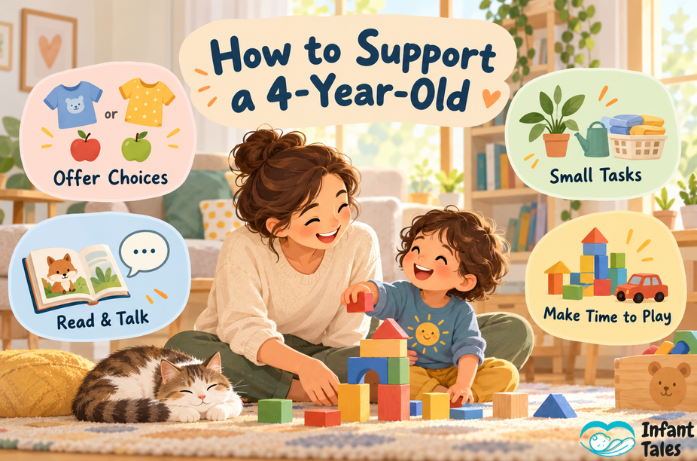
How Can Parents Support a 4-Year-Old?
Four-year-olds learn best through everyday experiences, play, conversation, and simple routines. You do not need to make every moment educational.
Offer Simple Choices
Giving your child two clear options can help them feel more independent without making decisions too difficult.
For example, ask, “Do you want the blue shirt or the green one?” or “Would you like an apple or a banana?” Small choices help children practice decision-making while still giving parents a clear structure.
Let Them Help With Small Tasks
Simple responsibilities can make four-year-olds feel capable and included.
They can put toys away, carry napkins to the table, place clothes in the hamper, water a plant, or help with easy household jobs. Keep the tasks simple and focus more on effort than doing everything perfectly.
Read and Talk Every Day
Books and everyday conversations are a simple way to support language and thinking skills.
While reading, you can ask gentle questions like, “What do you think will happen next?” or talk about how a character might be feeling. Keep it relaxed so story time still feels enjoyable.
Protect Plenty of Playtime
Play is an important part of learning at this age.
Building with blocks supports problem-solving, drawing helps hand control, pretend play encourages creativity, and outdoor play builds coordination and confidence. Give your child plenty of time to explore and play without turning every activity into a lesson.
Should a 4-Year-Old Already Be Doing Schoolwork?
It is common for parents to start thinking about school readiness around age four. You may hear about handwriting, counting, phonics, worksheets, or other early learning activities and wonder if your child should already be doing the same.
But learning at this age does not have to look like formal schoolwork. Four-year-olds can learn through everyday activities such as counting ingredients while cooking, matching socks, looking at books, drawing, building with blocks, and talking about the world around them.
The goal is to keep learning simple and enjoyable. Play, movement, stories, conversation, and hands-on experiences can all help build important early skills without making your child feel pressured.
When Should Parents Talk to a Doctor?
Every child develops at their own pace, but parents should speak with a pediatrician if they notice something that feels concerning or if their child seems to be struggling with skills expected around age four.
The Healthy Children guidance from the American Academy of Pediatrics can help parents understand what is usually discussed during a four-year checkup, including growth, behavior, learning, and development.
The CDC also advises parents to talk with a healthcare provider if a child is not meeting developmental milestones, has lost skills they once had, or if there are concerns about speech, movement, learning, play, or behavior.
You do not need to wait until a problem becomes serious. Bringing up concerns early gives your child’s doctor a chance to look at the bigger picture, answer questions, and recommend extra support or developmental screening if needed.
Frequently Asked Questions
Final Thoughts
Children are typically considered preschoolers at the age of four, although the toddler years usually finish at age three. However, being four may feel like a mixture of being a toddler and a preschooler. Your child might be able to talk, be more confident, and more independent, but it may not be able to cope with its strong emotions, daily routines, and the moments when everything gets to be too much.
This is actually very normal. It is a lot for preschoolers to take in at once, like how to make friends, solve problems, express themselves, and do more things on their own than ever before.
The best advice is to let your child be independent, yet close enough to offer comfort and guidance when needed.
Looking for more simple, parent-friendly guidance for every stage of childhood? Explore more helpful tips and resources on Infant Tales.
Disclaimer
This article is for general informational purposes only and is not a substitute for professional medical advice. If you have concerns about your child’s development, speak with your pediatrician or healthcare provider.
About the Author
Geeta Yogi is a parenting writer who shares practical guidance about toddler and preschool development, childhood milestones, emotional growth, play, and everyday family routines. Her writing focuses on helping parents understand each developmental stage and support growing independence with realistic expectations and simple everyday strategies.