Authored by: A Caring Mom at Infant Tales
The truth is that it’s natural for parents to wish for a successful educational career of their children, but they have to understand that lessons that matter happen outside of textbooks and worksheets. Teaching life skills for kids means giving them tools to deal with daily life and make even the simplest decisions, take care of themselves and show love to others. All of this may be done with something very simple having a very big final impact.
Kids love being assigned real jobs. Letting them pour water, put the shoes away, help set the table, or remember what generally should go into their school bags give them a feeling of importance.
Don’t try to teach everything at once. Life skills should be taught through an endless number of attempts.
Table of Contents
Why Life Skills for Kids Matter
Children need more than academic knowledge to feel confident in everyday life. Getting dressed, communicating clearly, solving small problems, and taking responsibility all help them become more independent.
Many basic life skills for kids can begin during the preschool years. A young child may not fold clothes neatly, but they can place dirty clothes in a basket. They may not cook a meal, but they can wash fruit or carry napkins to the table.
Choose tasks that fit your child’s age and abilities, and remember that mistakes are part of learning.
According to UNICEF India, life skills help children handle everyday situations and develop abilities such as problem-solving, confidence, decision-making, empathy, teamwork, and communication. These skills often grow best when children get opportunities to practice them through real-life experiences.
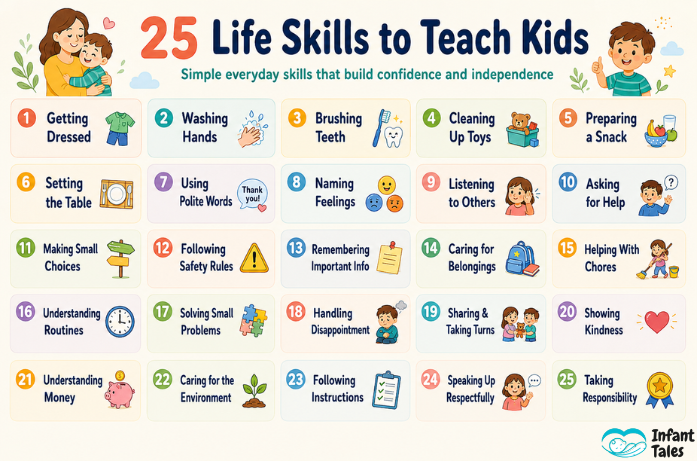
25 Life Skills to Teach Kids
There is no perfect age for mastering every skill. Use these ideas as gentle guidance and introduce them gradually as your child grows.
1. Getting Dressed
Start with easy steps such as pulling up pants, putting on socks, or choosing between two outfits. Buttons, zippers, and shoelaces can come later with practice.
2. Washing Hands Properly
Show your child how to use soap, wash between fingers, rinse, and dry their hands. Repeating the routine before meals and after the bathroom helps it become familiar.
3. Brushing Teeth
Young children still need supervision, but they can take part in brushing. Let them practice first, then help finish until they can clean their teeth more thoroughly.
4. Cleaning Up Toys
A messy room can feel overwhelming. Give one clear job at a time, such as putting blocks in a basket or returning books to the shelf.
5. Preparing a Simple Snack
Food preparation can be one of the most enjoyable life skills activities for kids. Children may wash fruit, peel a banana, spoon yogurt, or help make a sandwich with supervision.
6. Setting the Table
Little children can carry napkins or plastic cups, while older kids can arrange plates and utensils. It is a simple way to help them feel included in family routines.
7. Using Polite Words
Children learn “please,” “thank you,” and “excuse me” best when they hear those words often. Model the manners you want instead of turning every moment into a correction.
8. Naming Feelings
Help your child put words to feelings such as angry, nervous, disappointed, excited, or sad. Naming an emotion can make it easier for them to understand what is happening inside.
9. Listening to Others
Listening develops slowly. Practice taking turns during family conversations and gently remind your child to wait until another person has finished speaking.
10. Asking for Help
Independence also means knowing when help is needed. Teach simple phrases such as, “Can you help me?” or “I’m not sure what to do.”
11. Making Small Choices
Let your child choose between two shirts, snacks, or bedtime stories. Limited choices give children a safe way to practice decision-making without feeling overwhelmed.
12. Following Safety Rules
Teach safety gently. Practice holding hands near roads, staying close in busy places, recognizing trusted adults, and telling you when something makes them uncomfortable.
13. Remembering Important Information
As children grow, they can learn their full name, home address, and a parent’s phone number. A simple rhyme or song can make this easier to remember.
14. Caring for Their Belongings
Encourage children to return books, put shoes in the same place, close marker lids, and pack away toys. These habits make belongings easier to manage.
15. Helping With Chores
Simple chores teach teamwork. Young children can match socks, water plants, wipe a low table, or place clothes in a laundry basket.
16. Understanding Routines and Time
Young children may not understand clocks yet, but they can understand order. Phrases like “after breakfast we get dressed” help them know what comes next.
17. Solving Small Problems
Before fixing every problem, ask, “What could we try?” A missing shoe, tricky puzzle, or falling block tower can become a chance to think and experiment.
18. Handling Disappointment
Children will sometimes lose, hear “no,” or miss something they wanted. Acknowledge the feeling and stay nearby while they work through it instead of immediately trying to remove it.
19. Sharing and Taking Turns
Sharing can be hard for young children. Games, playground play, and simple timers can make taking turns easier to understand and practice.
20. Showing Kindness
Encourage your child to comfort a sibling, include another child in play, or make a card for someone who is unwell. Small acts help empathy grow.
21. Understanding Money
Explain that money is used to buy things and that families sometimes wait and save before purchasing something they want. Keep the lesson simple and age-appropriate.
22. Caring for the Environment
Children can put rubbish in the bin, turn off lights, avoid wasting water, and help care for plants. Small habits teach responsibility for shared spaces.
23. Following Instructions
Start with one-step directions such as, “Put your cup on the table.” When that becomes easy, move to simple two-step instructions.
24. Speaking Up Respectfully
Teach phrases such as “Please stop,” “I don’t like that,” or “Can I have a turn?” Children should know they can express preferences, discomfort, and boundaries respectfully.
25. Taking Responsibility for Mistakes
If your child spills something, let them help wipe it up. If they hurt someone’s feelings, guide them toward making things right. Responsibility should be taught without shame.
The State Council of Educational Research and Training (SCERT) Delhi also highlights important life skills such as self-awareness, empathy, decision-making, problem-solving, communication, and managing emotions. These abilities can help children make thoughtful choices and handle everyday challenges with greater confidence.
Easy Life Skills Activities for Kids at Home
You do not need special supplies or formal lessons. Some of the best practice happens during normal family life.
Try inviting your child to sort socks, put groceries away, water plants, pack a small bag for an outing, pour water into a cup, choose clothes for the next day, tidy the table, or organize toys.
These little jobs may take longer when a child helps, and the result may not look perfect. That is okay. The purpose is practice.
A helpful approach is to show the task first, do it together the next time, and then let your child try while you stay nearby. This offers support without taking over.
Life Skills for Kindergarten
When thinking about life skills for kindergarten, focus on basic self-care, communication, routines, and confidence.
A kindergarten-age child may be ready to open a lunchbox, carry a backpack, put on a jacket, wash hands, use the bathroom independently, remember belongings, and ask a teacher for help.
Social skills matter too. Children at this age are still learning how to join play, wait for a turn, handle disagreements, and explain when something bothers them.
Do not worry if reminders are still needed. Development is gradual, and children often move forward at different speeds.
The CDC explains that young children gradually develop skills such as following simple instructions, expressing emotions, taking turns, and becoming more independent. Parents can support this growth through everyday play, encouragement, routines, and positive guidance.
How to Teach Life Skills Without Pressure
One of the gentlest ways to teach is to invite your child to participate rather than making independence feel like a demand. Instead of saying, “You should know this,” try, “Would you like to do this part while I help with the rest?”
Teach one new responsibility at a time. Too many changes can frustrate everyone. Once one habit feels comfortable, slowly add another.
Try not to redo every imperfect task right away. A crooked bed, loosely folded towel, or slightly messy snack can still represent real effort. When children feel their effort matters, they are more willing to keep practicing.
Specific encouragement can help too. Saying, “You remembered where your shoes go,” or “You kept trying that zipper,” tells your child exactly what they did well.
How to Teach Life Skills Without Pressure
One child may happily prepare a snack but struggle to get dressed. Another may remember every school item but find disappointment much harder to manage.
Use your child’s maturity, abilities, and comfort level as your guide rather than comparing them with siblings, classmates, or children online.
The most useful life skills to teach kids are the ones that fit your child’s daily life right now.
Remember That Every Child Is Different
Teaching life skills for kids is not about pushing children to grow up too quickly. It is about giving them small chances to participate, make decisions, care for themselves, and recover when something does not go perfectly.
Start with one or two skills that fit naturally into your routine. Let your child watch, help, try, make a mess, and try again. Some days they may surprise you with how much they can do. On other days, they may need extra help with something they managed yesterday.
Keep offering patience, encouragement, and realistic expectations. Those ordinary moments of putting away shoes, pouring water, taking turns, and fixing small mistakes are quietly helping your child become more confident and capable, one little step at a time.
FAQs About Life Skills for Kids
Final Thoughts
Teaching life skills for kids is not about pushing children to grow up too quickly. It is about giving them small chances to participate, make decisions, care for themselves, and recover when something does not go perfectly.
Start with one or two skills that fit naturally into your routine. Let your child watch, help, try, make a mess, and try again. Some days they may surprise you with how much they can do. On other days, they may need extra help with something they managed yesterday.
Keep offering patience, encouragement, and realistic expectations. Those ordinary moments of putting away shoes, pouring water, taking turns, and fixing small mistakes are quietly helping your child become more confident and capable, one little step at a time.
Want more simple parenting tips that make everyday life easier? Explore more helpful guides on Infant Tales and support your child’s growth with confidence.
Disclaimer
This article is for general informational purposes only. Every child develops at their own pace, so choose activities and responsibilities that are safe and suitable for your child’s age and abilities.
About the Author
Geeta Yogi is a parenting writer who shares practical and easy-to-understand guidance about child development, independence, everyday routines, emotional skills, learning, and family life. Her writing focuses on helping parents teach useful skills through simple daily experiences while giving children time and encouragement to learn at their own pace.