
Authored by: A Caring Mom at Infant Tales
Taking your baby out in a stroller becomes more fun once they start looking around, following sounds, and showing interest in everything happening nearby. That is usually when parents begin wondering, when can baby sit in stroller instead of staying in a bassinet, carrycot, or infant car seat. For many babies, the regular stroller seat becomes suitable around 6 months, but some may be ready a little earlier or later depending on their development.
Age is only one part of stroller readiness. Your baby should have good head and neck control, enough upper-body strength to stay comfortably supported, and should not slump heavily forward or to the side. The stroller itself also matters, because some seats are approved for younger babies in a reclined position while others have specific age, weight, or developmental requirements. Checking both your baby’s posture and the stroller manufacturer’s instructions can help you make the transition more safely and confidently.
Table of Contents
- When Can Baby Sit in Stroller?
- Signs Your Baby Is Ready for a Stroller Seat
- When Can Baby Sit Upright in Stroller?
- When to Switch From Bassinet to Stroller Seat
- Try a Simple Stroller Readiness Check
- Always Use the Stroller Harness
- What If Baby Falls Asleep in the Stroller?
- Frequently Asked Questions
- Final Thought
- Disclaimer
When Can Baby Sit in Stroller?
Most babies can begin sitting in a regular stroller seat at around 6 months old, when they have better control of their head, neck, and upper body.
Some babies may be able to use a reclined stroller seat earlier, around 4 to 5 months, if the stroller is designed for younger infants and your baby has good head control.
There is no exact age that works for every baby. Instead of watching only the calendar, pay attention to your baby’s development and always check the stroller manual.
Development also matters when choosing a stroller position. According to Pathways’s stroller guidance, babies who cannot yet sit well generally need a reclining or bassinet-style setup, while babies around 6–12 months may be ready for a more upright seat with appropriate support.
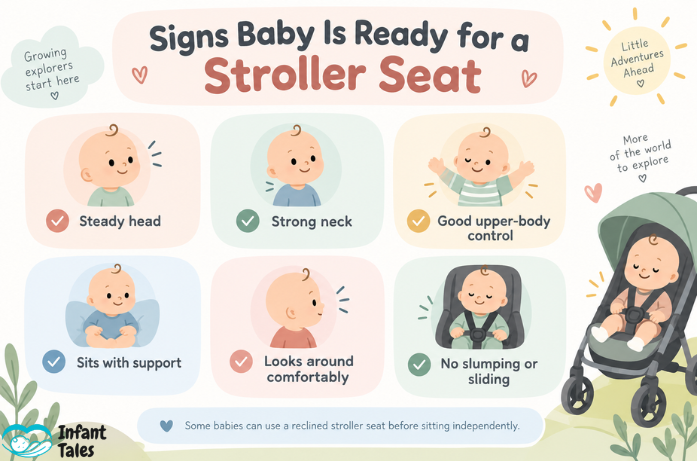
Signs Your Baby Is Ready for a Stroller Seat
Your baby’s body will often tell you more than their age.
Look for these signs:
- Your baby can hold their head upright without frequent wobbling.
- They have stronger neck and upper-body control.
- They can sit comfortably with support.
- Their body does not immediately fold forward.
- They can look around while keeping their head steady.
- They do not continually slide or slump in the stroller seat.
Your baby does not necessarily need to sit independently on the floor before using every stroller seat. Some models can safely support younger babies in a reclined position.
Can a 4-Month-Old Sit in a Stroller?
Some 4-month-old babies may be ready for a reclined or semi-reclined stroller seat, especially if they have good head and neck control.
However, most babies at this age are not ready to sit fully upright for long periods.
If your baby’s head still falls forward or becomes wobbly when tired, continue using a more supportive position and try again later.
Can a 5-Month-Old Sit in a Stroller?
A 5-month-old may be ready to use a stroller seat if they have steady head control and your stroller manufacturer allows it.
At this age, babies can develop very differently. One baby may sit comfortably with support, while another may still need more time.
A partially reclined position is often a comfortable middle step before sitting completely upright.
When Can Baby Sit Upright in Stroller?
Many babies are comfortable sitting more upright at around 6 months, once their head and trunk control become stronger.
Still, six months should not be treated as a strict deadline.
If your baby slumps forward, leans strongly to one side, or struggles to hold their head steady, recline the stroller seat and wait a little longer.
Comfort and proper support matter more than reaching a certain age.
When Can Baby Sit in Stroller Without Car Seat?
For many babies, the transition from an infant car seat to the regular stroller seat happens around 6 months.
Your baby may be ready earlier or later depending on their development and the stroller design.
Before making the switch, check that your baby’s head remains steady and that they can stay comfortably supported in the stroller seat.
Always follow the age, weight, and developmental guidelines provided with your stroller.
When to Switch From Bassinet to Stroller Seat
The move from a bassinet to stroller seat often happens when your baby becomes stronger and more interested in looking around.
Some babies also outgrow their bassinet because they reach its weight limit or begin rolling, pushing up, or becoming more active.
Check your bassinet instructions carefully because different models have different limits.
Do not move your baby into the regular stroller seat simply because they seem bored. Their body should also be ready for the new position.
Try a Simple Stroller Readiness Check
Before your first long outing, let your baby try the stroller seat at home.
Buckle the harness properly and place the seat in an approved reclined position.
Watch your baby for several minutes.
Does their head remain steady? Do they stay centered in the seat? Does their chin remain comfortably away from their chest?
If your baby repeatedly slumps or looks uncomfortable, recline the seat more or return to the previous stroller setup for another week or two.
Babies can gain a surprising amount of strength in a short time.
Signs the Stroller Seat May Be Too Upright
Sometimes babies look ready at first but become tired after several minutes.
Watch for:
- Head falling forward
- Chin resting against the chest
- Strong leaning to one side
- Sliding downward in the seat
- Difficulty keeping the upper body steady
If you notice these signs, adjust the stroller to a more reclined position if your model allows it.
There is no benefit in rushing your baby into sitting fully upright. For babies under 6 months who cannot yet sit well, child safety guidance from the Family Health Service recommends choosing a pushchair that can recline to a horizontal or nearly horizontal position and following the manufacturer’s instructions.
Always Use the Stroller Harness
Always secure your baby with the stroller harness, even on short walks. A properly fitted five-point harness helps prevent slipping, leaning forward, or trying to climb out as your baby becomes more active.
Check the straps regularly as your baby grows, and use the stroller brakes whenever you stop. Avoid hanging heavy bags from the handles, as this can affect the stroller’s balance and increase the risk of tipping.
This is the strongest authority link of the three for that section because the AAP specifically recommends harness use, stroller brakes, following age and weight limits, and avoiding heavy bags on handlebars.
What If Baby Falls Asleep in the Stroller?
It is very common for babies to doze off during a stroller walk, especially when the movement is soothing. If your baby falls asleep, keep an eye on their head and neck position and make sure they are not slumped forward or leaning awkwardly to one side.
If your stroller allows it, recline the seat to give your baby better support while you continue the walk. Keep the harness fastened and never add loose pillows, blankets, or extra padding around your baby.
A stroller is best used for travel rather than as a regular sleep space. For longer naps or nighttime sleep, move your baby to a firm, flat, approved sleep surface when practical.
What About Premature Babies?
If your baby was born prematurely, it can be more helpful to look at their corrected age and developmental readiness rather than calendar age alone. Corrected age takes into account how early your baby was born and is often used when looking at milestones such as head control, sitting, and overall muscle strength.
Some premature babies may need extra time to develop the neck, shoulder, and core strength needed for a more upright stroller position. Watch for steady head control, good posture with support, and the ability to stay comfortably centered in the seat without slumping or becoming tired quickly.
If your baby was born very early or has concerns with muscle tone, movement, or development, speak with your pediatrician or physical therapist before changing stroller positions. It is also important to follow the stroller manufacturer’s minimum age, weight, and seating recommendations.
When Can Baby Use a Jogging Stroller?
A jogging stroller may be suitable for everyday walking before your baby is old enough to actually go jogging.
Running creates much more movement than walking, so many manufacturers recommend waiting until babies have stronger head and neck control.
Always check the instructions for your particular jogging stroller before running with your baby.
Frequently Asked Questions
Final Thought
Knowing when can baby sit in stroller is less about reaching one exact age and more about noticing when your baby feels strong, steady, and comfortable. Around 6 months is common, but every baby develops in their own time, so there is no need to compare or hurry.
Follow your baby’s cues, use the stroller position recommended for their stage, and make the transition gradually. Before long, your little one will be sitting up, taking in the world with wide eyes, and turning ordinary walks into some of your sweetest everyday memories.
Every baby reaches milestones in their own time. Keep watching your little one’s cues, follow your stroller instructions, and enjoy each new stage together. For more gentle baby-care and parenting tips, explore more helpful guides on Infant Tales.
Disclaimer
This article is for general informational purposes only and is not a substitute for professional medical advice. If you have concerns about your baby’s development, posture, or stroller readiness, speak with your pediatrician and always follow the stroller manufacturer’s safety instructions.
About the Author
Geeta Yogi is a parenting writer who shares practical guidance about baby development, stroller safety, everyday outings, and infant milestones. Her writing focuses on helping parents recognize readiness signs, use baby gear safely, and feel more confident as their little ones grow into each new stage.