Authored by: Geeta Yogi
Most babies take their first independent steps around 12 months, but the timing varies widely. Some begin walking as early as 9 months, while others start closer to 17 or 18 months. What matters is the pattern of developing strength, balance and movement skills—not whether your baby walks before another child. Walking is not a competition; every child develops this skill on their own timeline.
The CDC lists taking a few steps independently as a milestone most children reach by 15 months and walking without holding on as an 18-month milestone. Before those first steps, babies commonly pull to stand, balance briefly and cruise along furniture. This guide explains the walking timeline, readiness signs, safe ways to help and when to speak with your pediatrician.
When Do Babies Start Walking?
Many babies take their first independent steps around their first birthday, but there is no single correct walking age. Some babies begin walking as early as 9 months, while others start closer to 17 or 18 months. Taking one or two unsupported steps counts as beginning to walk; steady, confident walking usually develops afterward through practice.
The CDC’s developmental milestones should be treated as checkpoints rather than deadlines. The CDC lists taking a few independent steps as something most children can do by 15 months and walking without holding on as an 18-month milestone. A child’s overall progress such as gaining strength, pulling to stand, balancing and cruising is more informative than comparison with another child.
For babies born more than three weeks early, development may be assessed using adjusted or corrected age. The American Academy of Pediatrics recommends considering adjusted age when tracking a premature baby’s milestones until approximately 2 years of age.
Signs Your Baby Will Walk Soon
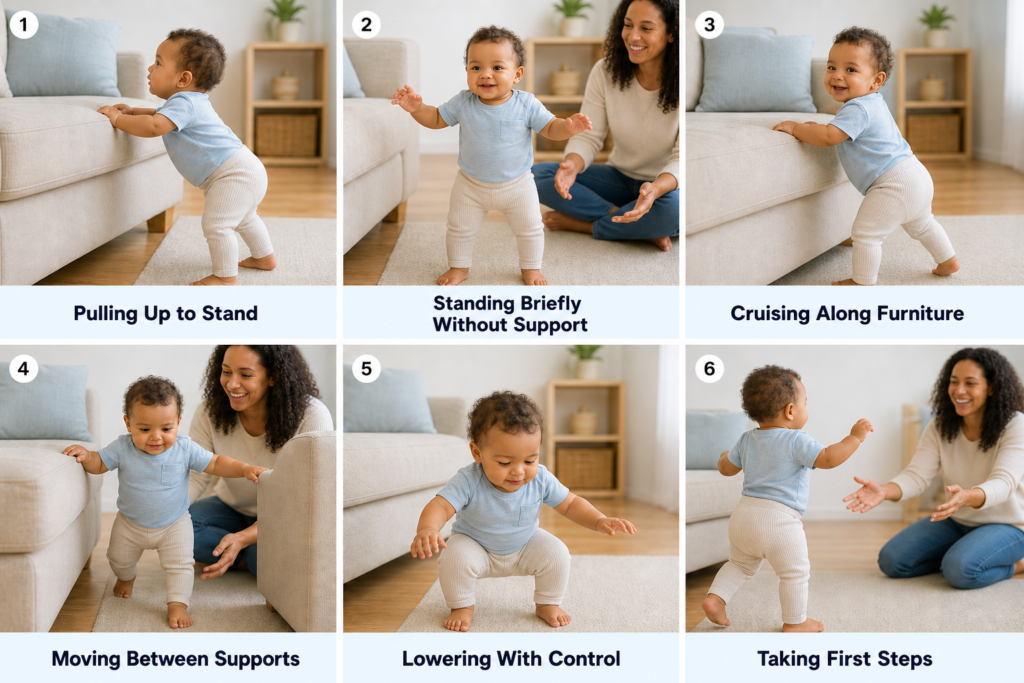
Learning to walk is a gradual process, not a single event. The following signs show that your baby is developing the strength, balance and coordination needed for independent steps. However, no individual sign can predict exactly when your baby will start walking. Some babies move through these stages quickly, while others practice them for several weeks or months.
1. Pulling Up to Stand
Pulling up to stand using a stable sofa or another secure piece of furniture is one of the clearest signs that your baby is developing the leg and core strength required for walking. Early attempts may look unsteady, and your baby may need time to learn how to lower themselves safely.
2. Standing Briefly Without Support
Your baby may begin letting go of the furniture and standing independently for a few seconds. They may place their feet wide apart or hold their arms out to improve their balance. These brief attempts help them learn how to stay upright without relying on their hands.
3. Cruising Along Furniture
Cruising means taking sideways steps while holding onto furniture. It teaches your baby to shift their weight from one foot to the other, an essential skill for independent walking. Some babies cruise for months, while others begin taking unsupported steps soon afterward.
4. Moving Between Supports
As balance and confidence improve, your baby may reach from one piece of furniture to another or take a small step across a gap. This shows that they are learning to plan their movements while relying less on continuous support.
5. Lowering Themselves With More Control
Instead of dropping suddenly to the floor, your baby may begin bending their knees and lowering themselves into a sitting or squatting position. Controlled lowering demonstrates improving leg strength, coordination and balance.
6. Taking Supported or Independent Steps
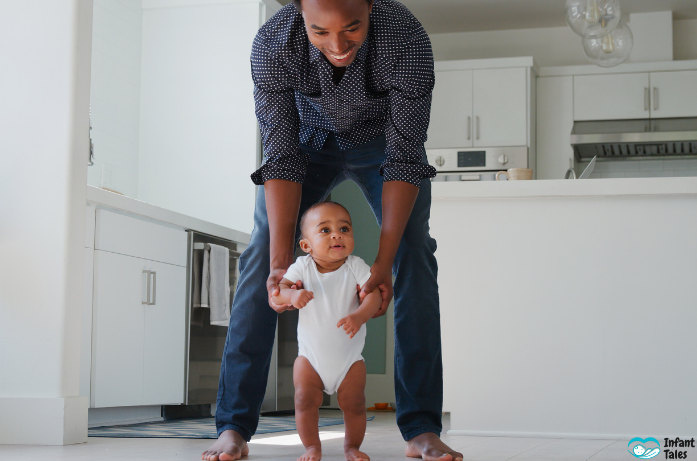
Your baby may initially take steps while holding your hands before attempting one or two steps without help. Early independent steps are usually wide, unsteady and followed by a fall or a return to crawling. That is a normal part of developing balance and confidence.
Note: Not every baby will display all these signs in the same order. Some babies skip crawling, some cruise for a long time and others begin walking soon after learning to stand. Look for continuing progress rather than expecting a fixed sequence.
Baby Walking Milestones by Age
Baby walking skills develop gradually, and the timeline is different for every child. According to the CDC, walking while holding on to furniture is a milestone most babies reach by 12 months, taking a few independent steps is a milestone most reach by 15 months, and walking without holding on is a milestone most reach by 18 months. These ages are checkpoints rather than deadlines, so focus on steady progress in strength, balance and coordination instead of comparing your baby with another child.
What you should enjoy most is the quality time you spend with your baby while they are learning a new skill. Babies are also great teachers because, as they learn to walk, they remind us that we can learn any skill through consistent effort and by learning from failure. It is a journey towards success through effort, and your baby will experience that journey too.
Earlier Movement Foundations
Rolling, sitting and crawling can help babies develop strength and coordination before walking, but they do not determine exactly when a baby will take their first steps. Some babies crawl on their hands and knees, while others scoot, bottom-shuffle or find another way to move. A baby may also skip crawling and progress towards pulling up and cruising.
By 12 Months: Pulling Up and Cruising
As their leg strength and balance improve, many babies begin pulling themselves to stand and taking sideways steps while holding stable furniture. Pulling to stand and walking while holding furniture are among the movement milestones most babies reach by 12 months. Secure nearby furniture and stay close while your baby practices.
By 15 Months: Taking a Few Independent Steps
The CDC lists taking a few steps independently as a milestone most children reach by 15 months. These first steps are usually wide and unsteady, and your baby may frequently fall or return to crawling. This is a normal part of developing balance, coordination and confidence.
By 18 Months: Walking Without Support
The CDC lists walking without holding on to anyone or anything as a milestone most children reach by 18 months. Early walking may still look unsteady, and toddlers commonly hold their arms out or keep their feet wide apart for balance. Speak with your pediatrician if your child is not walking independently by 18 months, loses a previously acquired skill or if you have other concerns about their movement.
How to Help Your Baby Learn to Walk Safely
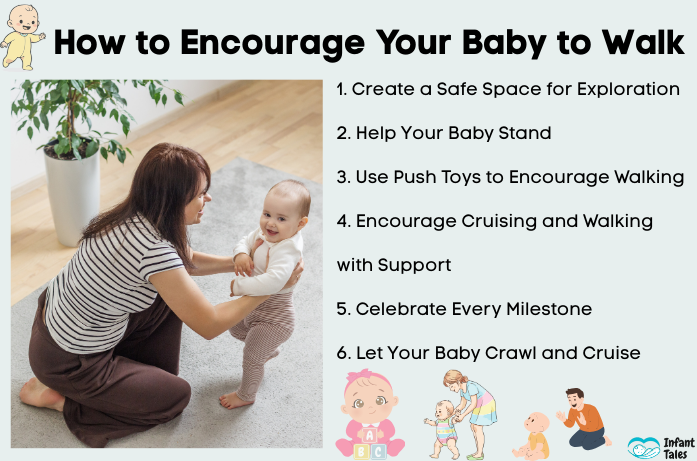
Babies learn to walk through regular opportunities to move, stand, cruise and practice balance—not by being rushed or pulled into position. You can help your baby learn to walk by providing safe floor space, stable furniture, supervised practice and encouragement while allowing your baby to lead.
The goal is not to make your baby walk sooner. It is to help them develop strength, balance and confidence safely. The CDC recommends giving babies opportunities to practice walking independently, hold onto safe furniture or use a stable push toy rather than a traditional seated baby walker.
1. Create a Clear, Safe Practice Area
Choose a flat, uncluttered area where your baby can move on a firm, non-slip surface. Remove loose rugs, electrical cords, small objects and unstable furniture from their path, and avoid slippery socks on smooth floors. Anchor furniture your baby may use for support, protect sharp corners and block access to stairs. Stay within reach while your baby practices because childproofing reduces risk but does not replace supervision.
2. Let Your Baby Pull Up and Lower Down
Place an interesting toy on a stable sofa or another low, securely anchored surface, and allow your baby to pull themselves up when ready. If they reach for you, offer your hands for balance, but let them do the lifting instead of pulling them upright. Show them how to bend their knees and lower themselves back to sitting because learning to get down safely is just as important as learning to stand.
3. Encourage Cruising Along Stable Furniture
Once your baby can stand with support, place toys a short distance apart along a stable sofa to encourage sideways stepping. Keep the available supports close together rather than creating gaps your baby must cross. Stay within reach and make sure the furniture has no sharp edges and cannot slide or tip over.
4. Use a Stable Push Toy When Your Baby Is Ready
A push toy can provide moving support after your baby can pull themselves up and cruise along furniture. Choose a sturdy, weighted push toy with a wide base and wheels that will not move too quickly. Use it only on a flat, clear surface with close supervision. A push toy is different from a traditional seated baby walker, which pediatric safety experts advise against using.
5. Give Your Baby Plenty of Floor Time
Regular floor time allows your baby to crawl or scoot, kneel, pull up, squat and practice moving between positions. Limit long periods in swings, bouncers or activity seats that restrict free movement. You do not need to turn every floor session into a walking lesson—ordinary movement, exploration and play all provide valuable practice.
6. Encourage Every Attempt Without Rushing
Place a favorite toy—or yourself—a short distance away and invite your baby to move towards it, but never force them. Offer calm praise when they pull up, cruise, balance or try again after falling. Stop when your baby appears tired or frustrated. Walking confidence develops through repeated, low-pressure opportunities rather than pressure or comparison with another child.
Are Baby Walkers Safe—and Do They Help Babies Walk?
Traditional seated baby walkers with wheels are not recommended at any age. Despite their name, they do not help babies learn to walk and may delay independent walking. They also allow babies to move quickly and reach stairs, hot objects, pools and other hazards before an adult can react. The American Academy of Pediatrics strongly advises parents not to use them.
Push toys are different from seated baby walkers. Once your baby can pull themselves up and cruise, a sturdy, weighted push toy may provide walking practice on a flat, uncluttered surface with close supervision. Choose one with a wide base that cannot tip easily or roll faster than your baby can control.
Safer Alternatives to a Seated Baby Walker
- Supervised floor play that allows your baby to move freely
- Cruising along stable, securely anchored furniture
- A sturdy, weighted push toy when your baby is developmentally ready
- A stationary activity center without wheels for contained play—not for teaching walking
From a walking-development perspective, a traditional seated baby walker is not worth buying. It provides no walking benefit and introduces avoidable injury risks.
How to Keep Your Baby Safe While They Learn to Walk
Once your baby begins pulling up, cruising and walking, they can reach hazards that were previously inaccessible. Recheck the entire home from your baby’s height—not only the area where they usually practice walking.
- Secure furniture and televisions: Anchor dressers, bookshelves, television stands and other heavy furniture to the wall so they cannot tip when your baby pulls on them.
- Block stairs and dangerous rooms: Install appropriate safety gates at the top and bottom of stairs. Use a hardware-mounted gate at the top of a staircase, and lock access to balconies, garages, bathrooms and other hazardous areas.
- Remove objects your baby may grab: Move electrical cords, tablecloths, hot drinks, medicines, cleaning products, sharp objects and choking hazards completely out of reach.
- Protect corners and slippery surfaces: Remove sharp-edged furniture from common walking paths or install securely attached corner protectors. Keep floors dry and remove loose rugs that may slide or bunch up.
- Choose appropriate footwear: Bare feet are generally suitable on a safe indoor surface. For outdoor walking, choose comfortable, flexible, closed-toe shoes with non-slip soles rather than stiff shoes designed to shape or support the foot.
- Supervise actively: Stay close enough to respond quickly, particularly near furniture, doors, stairs and water. Safety equipment reduces risk, but it cannot replace attentive adult supervision.
Small falls are a normal part of learning to walk. Keep the environment safe, remain calm and comfort your baby without making every ordinary tumble frightening. Contact your healthcare provider if your baby experiences a serious fall, behaves unusually afterward or if you are concerned about an injury.
When to Talk to a Pediatrician About Your Baby’s Walking
Babies develop at different rates, so an earlier or later walking timeline does not automatically indicate a problem. However, developmental milestones are useful checkpoints, and you do not need to wait until 18 months to raise a concern.
Contact your baby’s pediatrician if:
- Your baby is not pulling themselves up or walking while holding furniture by 12 months.
- Your baby is not taking a few independent steps by 15 months.
- Your baby is not walking without support by 18 months.
- Your baby loses a movement skill they could previously perform.
- Your baby appears to experience pain, consistently avoids placing weight on one or both legs, or moves one side of their body very differently from the other.
- You have any concern about your baby’s strength, balance, coordination or overall development.
These signs do not necessarily mean that your baby has a developmental problem. Your pediatrician can review your baby’s overall progress, perform developmental screening and recommend further evaluation or early-intervention support when appropriate. Acting early can help address a genuine concern without creating unnecessary pressure around the walking timeline.
Is It Normal for a Baby to Walk Without Crawling?
Yes. Some babies never crawl on their hands and knees before they begin walking. They may scoot on their bottom, move on their stomach, roll to reach objects or progress directly from sitting to pulling up, cruising and taking independent steps.
The American Academy of Pediatrics explains that skipping crawling or learning movement skills in a different order is not necessarily a cause for concern. What matters more is your baby’s overall progress and whether they use both sides of their body in a reasonably coordinated way.
Continue providing supervised floor time and opportunities to move freely, but do not force your baby to crawl. Speak with your pediatrician if you notice a loss of skills, substantial differences between the two sides of the body or concerns about your baby’s strength, coordination or overall development.
Frequently Asked Questions About Baby Walking
Final Takeaway
Many babies take their first independent steps around their first birthday, although the walking timeline varies. Rather than trying to make your baby walk faster, provide safe floor time, stable furniture, supervised practice and plenty of encouragement. Pulling up, standing briefly and cruising are signs of progress—not a countdown to one particular day.
Your baby is not competing with another child. Celebrate the attempts, wobbles and small steps while allowing their development to progress at its own pace. Speak with your pediatrician if your baby is not taking a few independent steps by 15 months, is not walking without support by 18 months, loses a previously acquired skill or if you have any concerns about their movement.
Excited to see your baby’s first steps? Visit Infant Tales for expert tips and support on every milestone. We’re here to guide you through each step of the journey!
Disclaimer
If you have concerns about your baby’s development or walking milestones, always consult with your healthcare provider. Every baby is unique, and your pediatrician can provide personalized advice tailored to your baby’s needs.