Authored by: A Caring Mom at Infant Tales
Getting to see your child’s ears with tiny earrings is one of the most magical moments you will experience as a parent. However, after the piercing, it is natural to have a lot of questions regarding healing process, redness, care and changing those starter earrings. The question of how long does baby ear piercing take to heal usually comes as a first one.
On average, it takes about 6 to 8 weeks for the piercing in baby’s earlobe to heal. While on the outside it may seem that the healing process is already over, on the inside the skin requires some time.
Therefore, even if everything seems fine a couple of weeks after the procedure, wearing starter earrings and taking care of the piercing is essential.
Table of Contents
- How Long Does Baby Ear Piercing Take to Heal?
- Baby Ear Piercing Healing Timeline
- What Can Slow Baby Ear Piercing Healing?
- Simple Baby Ear Piercing Aftercare
- What Is the Best Age for Baby Ear Piercing?
- Before Piercing Day: Quick Parent Checklist
- Needle or Piercing Gun: What Parents Should Ask
- Normal Healing vs. Possible Infection
- When Can You Change Baby’s First Earrings?
- FAQs About Baby Ear Piercing
How Long Does Baby Ear Piercing Take to Heal?
Most baby earlobe piercings take around 6 to 8 weeks to heal. Some babies may heal a little sooner, while others need extra time, especially if the ears get touched, rubbed, or irritated often.
According to Cleveland Clinic, earlobe piercings typically take about 6 to 8 weeks to heal, although factors like the jewelry, piercing method, and individual healing can affect the timeline.
The confusing part is that the ears can look healed before they are actually fully healed. The redness may disappear and everything may seem normal, but the skin inside the piercing is still delicate.
So even if those tiny ears look perfect after a couple of weeks, try not to change the earrings too soon. Keep the starter earrings in place, clean the area gently, and avoid unnecessary touching while the piercing continues to heal.
Baby Ear Piercing Healing Timeline
Every baby heals a little differently, but knowing what usually happens during each stage can make the first few weeks feel much less worrying.
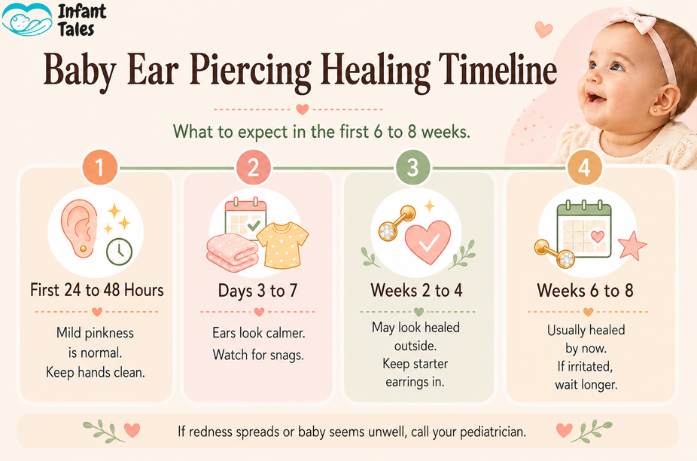
First 24 to 48 Hours
During the first couple of days, your baby’s ears may look slightly pink, swollen, or tender. Your baby may also touch or rub the ears because the new earrings feel unfamiliar.
Try to leave the earrings alone as much as possible and always wash your hands before touching the area. If redness starts spreading, swelling gets worse, or your baby develops a fever or seems unwell, contact your pediatrician.
Days 3 to 7
By the end of the first week, the ears should usually start looking calmer. You may notice a small amount of clear or pale crust around the earrings, which can happen during normal healing.
Be careful with towels, blankets, clothing, and little fingers because fresh earrings can easily get caught. Dress your baby gently and pat around the ears carefully after bath time.
Weeks 2 to 4
At this stage, the ears may look almost completely healed, but the skin inside the piercing is still recovering. This can make it tempting to change the starter earrings too soon.
It is better to keep the original earrings in place and continue the same simple aftercare routine. Even when the outside looks normal, the piercing still needs more time to become fully settled.
Weeks 6 to 8
By around six to eight weeks, many baby earlobe piercings are well healed. The ears should look comfortable without ongoing redness, swelling, soreness, warmth, or discharge.
If everything looks healthy, you may be able to change the earrings after following the advice of your pediatrician or piercing professional. If there is still some irritation, simply give the ears a little more time to heal.
What Can Slow Baby Ear Piercing Healing?
Sometimes one ear heals beautifully while the other stays irritated. A few everyday things can slow the healing process.
Touching the Earrings Too Often
Babies love touching their faces and ears.
Unfortunately, repeated touching can bring germs to a fresh piercing or keep irritating the delicate skin.
Wash your own hands before checking the earrings and gently redirect your baby when little fingers keep reaching toward them.
Earring Backs That Are Too Tight
Parents often look carefully at the front of the ear but forget to check behind it.
The backing should be secure without squeezing tightly against the earlobe.
If the backing appears to be sinking into the skin or becoming embedded, contact a healthcare professional instead of trying to pull it out yourself.
Snagging on Clothes and Towels
Fresh earrings somehow seem to catch on everything.
Towels, sweaters, blankets, bibs, hairbrushes, and clothing pulled over the head can tug on the piercing.
For the first few weeks, clothes with wider necklines, buttons, or zippers may make dressing easier.
Metal Sensitivity
Sometimes redness is caused by irritation from the jewelry rather than an infection.
Nickel is a common cause of jewelry-related skin reactions. Ask the piercing professional exactly what the starter earrings are made from and choose high-quality jewelry suitable for fresh piercings.
Simple Baby Ear Piercing Aftercare
Aftercare does not need to become another complicated parenting routine.
Gentle and consistent care is usually the easiest approach.
Wash Your Hands First
Always wash your hands with soap and water before touching your baby’s earrings.
That rule applies to grandparents and older siblings too, no matter how excited they are about those tiny sparkly ears.
Keep Cleaning Simple
Follow the aftercare instructions provided by your pediatrician or qualified piercing professional. The American Academy of Dermatology (AAD) also recommends keeping newly pierced ears clean, washing your hands before touching them, and leaving the starter jewelry in for at least six weeks.
Sterile saline is commonly used for gentle piercing care. Avoid trying several home remedies or harsh products at once, because irritated skin does not necessarily heal faster when it is cleaned more aggressively.
Should You Twist Baby Earrings?
Parents often receive conflicting advice about twisting fresh earrings.
Some older recommendations encouraged rotating them regularly, while modern professional piercing guidance generally advises avoiding unnecessary jewelry movement during healing.
The safest approach is to follow the instructions provided by the qualified professional caring for your baby’s piercing and avoid repeatedly playing with the earrings.
Be Careful During Bath Time
You can still keep your baby clean without making bath time stressful.
Rinse shampoo and soap away carefully so products do not collect around the earring posts.
Afterward, gently pat around the ears instead of rubbing them with a towel.
Avoid Swimming While the Piercing Is Fresh
Pools, hot tubs, lakes, and other bodies of water can expose a fresh piercing to bacteria.
If swimming lessons or a holiday are coming up, ask your baby’s pediatrician or piercing professional when it is safe to return to the water.
What Is the Best Age for Baby Ear Piercing?
There is no single age that works perfectly for every family. The best age for ear piercing for babies can depend on family tradition, culture, your baby’s health, and how comfortable you are with aftercare.
If you prefer to pierce during infancy, around 6 months or later can be a practical time for many families, although there is no universal medical minimum age. Some parents wait until after the first routine vaccinations, while others prefer waiting until their baby is closer to 1 year old.
A good age to pierce ears is ultimately a time when your baby is healthy and you can keep the new piercing clean and protected while it heals.
Parents researching newborn ear piercing age should speak with their pediatrician first rather than choosing a date only because a jewelry store or piercing studio allows very young babies.
Before Piercing Day: Quick Parent Checklist
A little preparation can make the appointment much easier.
Before you go:
- Choose a day when your baby is healthy.
- Feed your baby beforehand if possible.
- Bring a pacifier or familiar comfort item.
- Choose clothing that will not rub against the ears.
- Ask what material the starter earrings are made from.
- Ask whether the piercing equipment is sterile or single-use.
- Choose someone experienced with babies and children.
- Get clear aftercare instructions before leaving.
You should never feel awkward asking questions about hygiene or equipment.
A trustworthy professional should be comfortable explaining how they keep the procedure clean and safe.
Needle or Piercing Gun: What Parents Should Ask
Instead of focusing only on whether the provider uses a needle or a piercing device, ask about the complete procedure.
Traditional reusable piercing guns have raised concerns because some parts can be difficult to sterilize completely and the jewelry may sometimes fit too tightly.
Some healthcare offices and piercing providers now use sterile single-use systems.
Ask whether the part touching your baby’s ear is sterile or disposable, whether the provider regularly works with infants, and whether the starter jewelry leaves enough room for normal swelling.
Those questions are often more useful than simply asking, “Do you use a gun or needle?”
Normal Healing vs. Possible Infection
This is probably the part parents worry about most.
During the first few days, mild localized redness, slight tenderness, minor swelling, or a little pale crust can happen.
The important thing is that symptoms should gradually improve rather than become worse.
Contact your pediatrician if you notice:
- Redness spreading beyond the piercing
- Increasing swelling
- Significant warmth or pain
- Thick yellow or green discharge
- Fever
- An earring backing becoming embedded
- Your baby seeming unusually uncomfortable or unwell
Because babies cannot tell us exactly what hurts, it is always okay to ask your pediatrician when something does not look right.
When Can You Change Baby’s First Earrings?
For most babies, it is better to wait until the original healing period is complete, usually around 6 to 8 weeks.
Before changing the jewelry, look carefully at both sides of the ear.
There should be no redness, swelling, soreness, recurring crusting, or discharge.
For the first replacement pair, choose simple, lightweight earrings made from a good-quality material. Avoid heavy earrings, hoops, or dangling styles that little fingers can easily grab.
Never force an earring through if the hole feels tight or painful.
FAQs About Baby Ear Piercing
Final Thoughts From One Mom to Another
So, how long does baby ear piercing take to heal? For most uncomplicated earlobe piercings, expect about 6 to 8 weeks, although every baby’s skin heals at its own pace.
You do not need to spend the whole day worrying over those tiny ears. Keep your hands clean, follow simple aftercare, protect the earrings from getting snagged, and occasionally check both the front and back of the earlobes.
Most importantly, notice whether things are getting better or worse. A little early redness that gradually disappears is very different from redness that keeps spreading.
Ear piercing can be a sweet family tradition or simply a special little milestone. Give those tiny ears enough time to heal, and whenever something does not feel right, asking your pediatrician is always a sensible choice.
Every little milestone can bring new questions. Explore more simple, mom-friendly baby care tips on Infant Tales to feel informed and confident along the way.
Disclaimer
This article is for general parenting information and is not a substitute for professional medical advice. Contact your baby’s healthcare provider if you notice fever, spreading redness, increasing swelling or pain, pus, embedded jewelry, or if your baby seems unwell.
About the Author
Geeta Yogi is a parenting writer who shares practical and easy-to-understand guidance about baby care, everyday health concerns, milestones, and common parenting questions. Her writing focuses on helping parents approach everyday decisions with useful information, gentle care, and confidence.