Written by a caring mom at Infant Tales
When my baby became a kindergartener, I imagined homeschooling to be about doing worksheets, using pencils, and studying at the desk. It took me only a short time to realize that not all good kindergarten activities at home require academic materials.
Children at this age are explorers by nature. They like touching, creating, questioning everything, and discovering how the world works. Instead of attempting to emulate the school experience, I choose simple activities which are enjoyable and simultaneously develop reading, mathematics, creative thinking, problem-solving, and other life skills in children.
Here are 25 such simple activities you can use without turning your house into a classroom.
Table of Contents
- Why Kindergarten Activities at Home Are Helpful
- 25 Easy Kindergarten Activities to Try at Home
- Literacy and Language Activities
- Math and Thinking Activities
- Science, Creativity and Fine Motor Activities
- Emotional, Social and Life-Skill Activities
- Make Learning Part of Everyday Life
- Follow Your Child’s Interests
- Frequently Asked Questions
- Final Thoughts
Why Kindergarten Activities at Home Are Helpful
Children learn best by touching, moving, exploring, and doing things hands-on. It is possible to foster a child’s ability to read, do mathematics, create something new, and solve problems through easy-to-do activities without having to impose any form of instruction on him or her.
These learning activities do not have to be anything out of the ordinary; they may include matching socks, counting fruit pieces, making block towers, or setting the table, among other simple tasks.
One does not have to spend a whole day instructing a child. All he needs are a couple of activities that the child finds interesting and entertaining.
25 Easy Kindergarten Activities to Try at Home
To make these activities easier to follow, I have divided them into four simple learning areas. You can choose the section that best matches your child’s mood, interests, or skills you want to practice that day.
Literacy and Language Activities
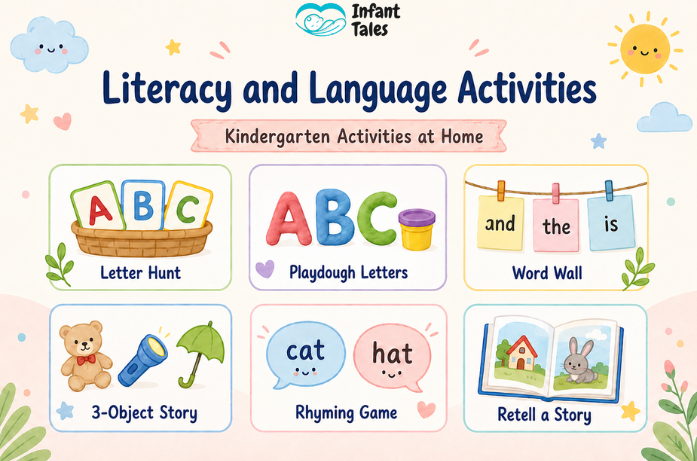
1. Go on a Letter Hunt
Choose one letter and ask your child to find objects around the house that begin with that sound.
For the letter B, they might find a book, ball, blanket, or banana.
It is an easy way to practice letter sounds without making it feel like homework.
2. Make Playdough Letters
Roll playdough into little snakes and shape them into uppercase and lowercase letters.
Let your child start with the letters in their own name.
This also gives little fingers useful practice for future writing.
3. Create a Family Word Wall
Write familiar words on small cards, such as Mom, Dad, Grandma, dog, milk, or your child’s name.
Place them somewhere your child can see regularly.
Children are often more interested in reading words that already mean something to them.
4. Tell a Three-Object Story
Pick three random objects, such as a spoon, teddy bear, and sock.
Ask your child to make up a story using all three.
You might hear a very strange story, but that’s part of the fun. It encourages vocabulary, imagination, and storytelling.
5. Play a Rhyming Game
Choose a simple word such as cat, sun, or log.
Take turns thinking of rhyming words.
Silly made-up words are welcome too. Playing with sounds can help children become more comfortable with early reading skills.
6. Retell a Favorite Story
After reading a picture book, ask your child what happened first, next, and last.
Try not to correct every little detail.
Questions such as “What happened after that?” or “How did the character feel?” can keep the conversation going naturally.
Math and Thinking Activities
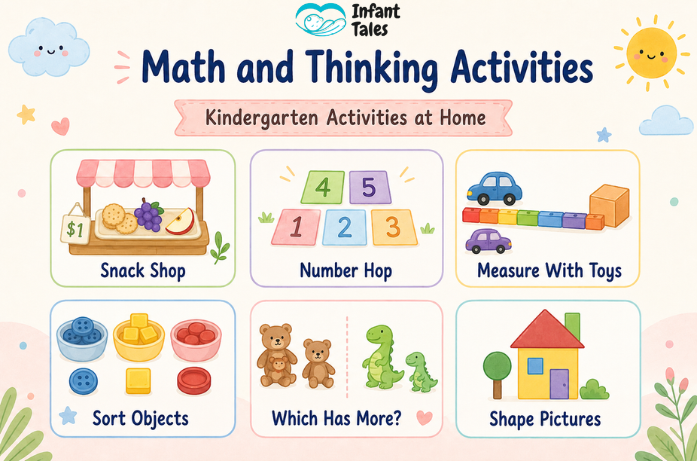
7. Open a Pretend Snack Shop
Use crackers, fruit pieces, or another snack and pretend your child is running a shop.
Ask for three crackers or five grapes.
Later, try simple questions such as, “I have two crackers. Can you give me two more?”
8. Make a Number Hop Game
Write numbers on separate pieces of paper and place them across the floor.
Call out a number and let your child jump onto it.
You can also ask them to find the number before 6 or after 3.
9. Measure With Toys
Measure your sofa using toy cars or your table using building blocks.
Ask your child which object is longer or shorter.
It is a playful introduction to measurement without needing a ruler.
10. Sort Household Objects
Collect safe items such as lids, blocks, socks, or large buttons.
Ask your child to sort them by color, size, or shape.
Sometimes let them decide how to sort the items. Their answer may surprise you.
11. Play “Which Has More?”
Create two small groups of toys.
Ask which group has more, fewer, or the same number.
Let your child count each group if they need help deciding.
12. Make Shape Pictures
Cut or draw circles, squares, rectangles, and triangles.
Ask your child to turn the shapes into a house, robot, animal, or silly creature.
This combines early math with creativity in a simple way.
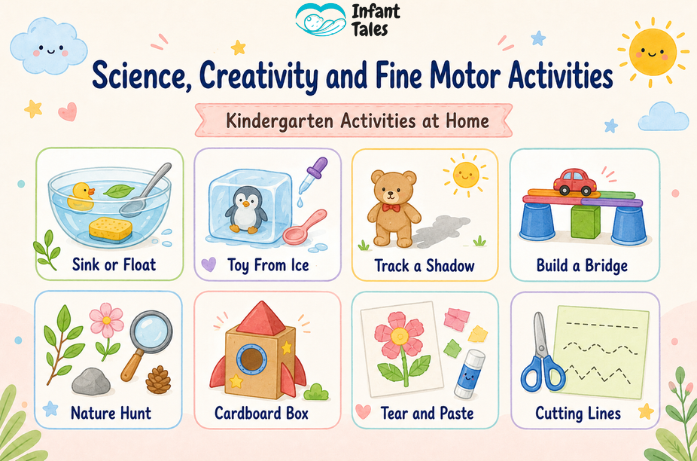
Science, Creativity and Fine Motor Activities
13. Try a Sink-or-Float Experiment
Fill a bowl with water and collect safe household objects such as a spoon, sponge, toy block, leaf, or plastic lid.
Before placing each item in the water, ask your child what they think will happen.
The guessing is just as important as finding the answer.
14. Rescue a Toy From Ice
Freeze a small plastic toy inside a container of water.
The next day, let your child use warm water, a spoon, or a dropper to free it.
Ask, “What do you think will make the ice melt faster?”
15. Track a Shadow
Place a toy outside in a sunny area and look at its shadow.
Come back later and see whether the shadow has moved or changed.
Simply noticing the difference can encourage curiosity and observation.
16. Build a Bridge
Give your child cardboard, cups, blocks, or craft sticks.
Ask them to build a bridge for a toy car or animal.
If it falls, let them try again before helping. Working out why something failed is part of the learning.
17. Go on a Nature Hunt
Take a walk and look for something rough, smooth, green, tiny, round, or colorful.
You can collect safe natural items or simply point them out.
This encourages observation while giving your child time outdoors.
18. Create From a Cardboard Box
Give your child an empty box and ask, “What could this become?”
Maybe it becomes a rocket, bus, house, shop, or animal hospital.
Try not to direct the design too much. Their own ideas are the most interesting part.
19. Make a Tear-and-Paste Picture
Give your child colored paper or old magazines.
Let them tear pieces and glue them onto paper to create an animal, rainbow, garden, or imaginary picture.
Tearing and gluing also gives little hands useful fine motor practice.
20. Practice Cutting Lines
Draw straight, curved, and zigzag lines on paper.
Let your child use child-safe scissors to follow them.
Their cutting does not need to be perfect. The goal is simply to practice control.
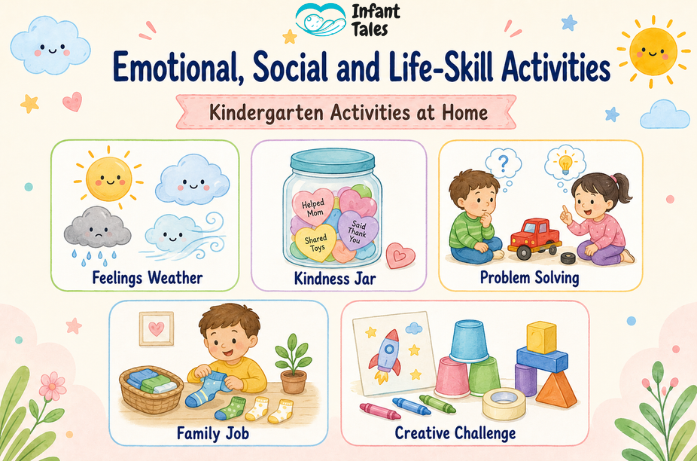
Emotional, Social and Life-Skill Activities
21. Give Feelings a Weather Report
Ask, “If your feelings were weather today, what would they be?”
Your child might say sunny, cloudy, stormy, or windy.
This can make it easier for young children to describe emotions they do not yet know how to explain.
22. Make a Kindness Jar
Write small acts of kindness on pieces of paper.
Ideas might include helping set the table, sharing a toy, drawing someone a picture, or giving a compliment.
Choose one whenever your family wants a little kindness challenge.
23. Practice Simple Problem-Solving
Give your child an everyday situation.
For example, “Someone is playing with the toy you want. What could you do?”
Let them think of more than one answer. It helps children practice handling everyday problems calmly.
24. Give Your Child a Real Family Job
Ask your child to match socks, water a plant, place napkins on the table, organize shoes, or count plates for dinner.
Children often feel proud when they are trusted with a real responsibility.
These everyday jobs can teach independence, counting, sorting, and confidence.
25. Try a Five-Minute Creative Challenge
Set out paper, blocks, cups, crayons, or tape.
Tell your child they have five minutes to create anything they want.
Then step back and let them decide.
This is one of my favorite kindergarten activities at home because there is no right answer. Children can plan, experiment, change their ideas, and proudly explain what they created.
Make Learning Part of Everyday Life
You do not need to schedule a special “learning hour” every day.
Count apples while putting groceries away. Look for letters on food boxes. Ask which towel is bigger. Talk about the weather while getting dressed.
Cooking is another easy learning opportunity. Children can count spoonfuls, compare ingredients, follow steps, and notice how food changes.
These small moments add up.
Try Asking One Good Question
Parents sometimes feel like we need to explain everything.
We really don’t.
A simple question can encourage more thinking than a long explanation.
Try asking:
- “What do you notice?”
- “What do you think will happen?”
- “How did you figure that out?”
- “Can you try another way?”
- “What would you change?”
Then give your child time to answer.
Young children often need a few extra seconds to organize their thoughts.
Follow Your Child’s Interests
If your child loves dinosaurs, count dinosaurs.
If they love cars, use toy vehicles to practice colors, numbers, and beginning sounds.
If animals are their favorite thing, create a pretend veterinary clinic.
Following your child’s interests can make learning feel more natural because they are already excited about the topic.
Don’t Worry About Perfect Activities
Some days, you may prepare a lovely activity and your child loses interest after five minutes.
That does not mean you failed.
Try something else later or simply stop for the day.
Children learn through free play, conversations, books, helping around the house, outdoor exploration, and even boredom.
You don’t need every minute to be educational.
Frequently Asked Questions
Final Thoughts
Learning at home does not have to be perfectly planned to be meaningful. Some of the best moments happen naturally while your child is playing, asking questions, helping with small chores, building something, or trying to solve a problem on their own.
Start with the activities your child seems most excited about and don’t worry about doing all 25. If something keeps them interested, repeat it. Kids often learn a lot through doing the same activity again in slightly different ways.
Most importantly, keep kindergarten activities at home light, playful, and pressure-free. Your encouragement, patience, and time together can make even a very simple activity feel special and those everyday learning moments are often the ones children enjoy the most.
Which activity would your kindergartener love most? Try one today, and explore more simple learning ideas and real-mom parenting tips on Infant Tales.
Disclaimer
This article is for general educational and parenting information only. Always supervise your child during activities involving water, scissors, food, or small objects, and choose materials appropriate for your child’s age and abilities.
About the Author
Geeta Yogi is a parenting writer who shares simple and practical ideas for early learning, creative play, child development, and everyday family activities. Her writing focuses on helping parents make learning enjoyable through hands-on activities, play, conversation, and easy routines children can explore at home.