
Authored by: A Caring Mom at Infant Tales
One whole week with your baby can feel like the shortest and longest week of your life. You may still be learning how to hold them comfortably, wondering whether every little sound is normal, and checking the diaper as if it contains important clues. If you have a 1 week newborn, all of this is very familiar territory.
During newborn week 1, your baby is adjusting to life outside the womb while you are adjusting too. There is no need for a perfect schedule yet. Most of these first days are about feeding, sleeping, cuddling, diaper changes, recovery, and slowly getting to know each other.
1 Week Newborn at a Glance
At one week old, babies are still in the very early newborn stage. They usually sleep for much of the day, wake often to feed, and depend on you for warmth, food, comfort, and safety.
| What you may notice | What is common around 1 week |
| Sleep | Lots of sleep, usually in short stretches |
| Feeding | Frequent feeds during the day and night |
| Diapers | Wet diapers increase as feeding becomes established |
| Movement | Jerky movements and strong newborn reflexes |
| Vision | Baby is most interested in faces and things close by |
| Routine | Feed, change, cuddle, sleep, and repeat |
| Umbilical cord | Often still attached and drying |
| Day and night | Baby may still have no idea which is which |
This is not a milestone race. A one-week-old is not expected to smile on purpose, hold their head steadily, or follow a neat daily routine.
UCSF Benioff Children’s Hospitals notes that babies may spend a little more time awake as the first week progresses and may enjoy looking at a parent’s face or hearing them talk and sing. Some newborns can also become fussy after a busy or stimulating day.
Feeding, Diapers and Weight in the First Week
1. Frequent feeding is normal. A one week newborn has a very small stomach, so feeding often during the day and night is expected. Breastfed babies may sometimes want to nurse again soon after a feed, especially during cluster feeding, while formula-fed babies may have their own feeding pattern.
2. Watch your baby’s hunger cues. Rooting, bringing hands toward the mouth, making sucking movements, and becoming restless can all be early signs of hunger. Crying usually comes later, so noticing these quieter cues may make feeding easier for both of you.
3. Diapers can tell you a lot. During the first days of newborn life, stools usually begin dark and sticky. As feeding becomes established, breastfed babies often have loose yellow stools, while formula-fed babies may have thicker yellow, green, or brown stools.
4. Wet diapers should become more regular. As your baby takes in more milk, you should gradually notice more wet diapers. If your newborn has far fewer wet diapers than expected, seems unusually sleepy, has a dry mouth, or is feeding poorly, contact your pediatrician.
5. Some weight loss can happen at first. Newborns commonly lose a little weight during the first few days after birth before they begin gaining again. Early checkups allow your doctor to look at your baby’s weight together with feeding, hydration, diapers, and overall health.
6. Ask for feeding support when needed. If breastfeeding is very painful, your baby struggles to latch, or feeds seem weak or difficult, reach out early. Your pediatrician or a lactation professional can help identify the problem and make feeding feel more manageable.
Sleep and a Newborn Routine First Week
If you searched for a newborn routine first week, you may be hoping for exact feeding and nap times.
At one week old, a strict schedule usually isn’t realistic.
A simple rhythm works better: your baby wakes, feeds, gets burped or changed, spends a little time quietly awake, and then sleeps again.
Some days this pattern may feel surprisingly peaceful. Other days your baby wants another feed almost the moment you thought you were finished.
Newborns can also be very noisy sleepers.
They may grunt, squeak, twitch, stretch, or make little sounds that send you straight over to the bassinet.
Safe sleep matters much more than getting your baby onto a schedule.
The CDC recommends placing babies on their backs for every nap and nighttime sleep. Use a firm, flat sleep surface with a fitted sheet and keep pillows, loose blankets, bumper pads, stuffed toys, and other soft objects out of the baby’s sleep area. Room-sharing without bed-sharing is also recommended, ideally until at least 6 months.
At night, keeping lights low and voices quiet may gradually help your baby learn that nighttime feels different from daytime.
But don’t try to keep a one-week-old awake during the day just so they will sleep longer at night. Their sleep rhythm is still developing.
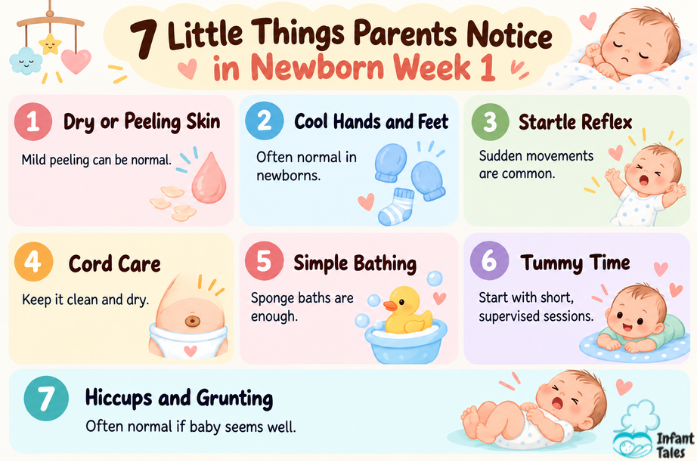
7 Little Things Parents Often Wonder About in Newborn Week 1
1. Peeling or Dry Skin
A little dryness or peeling can happen as newborn skin adjusts after birth. Try not to pick at it. If you notice blisters, spreading redness, oozing, or a rash that worries you, show it to your baby’s doctor.
2. Cool Hands and Feet
Newborn circulation is still adjusting, so the hands and feet can sometimes feel cooler than the chest or back. Slight color changes can also happen, but blue or gray coloring around the lips, tongue, face, or body needs urgent medical attention.
3. Startle Reflex and Sudden Movements
Those quick arm movements are often part of the normal Moro, or startle, reflex. You may also notice rooting, sucking, and a surprisingly strong little grip when your baby wraps their fingers around yours.
4. Umbilical Cord Care
Keep the cord stump clean and dry and allow it to fall off naturally. Do not pull it, even when it looks almost ready. Contact your baby’s doctor if you notice spreading redness, pus, a strong unpleasant smell, or significant bleeding.
5. Simple Bathing
Your newborn does not need a full bath every day. Gentle sponge cleaning is usually enough while the cord is still attached. Pay special attention to the diaper area and tiny neck folds where milk can collect.
6. Short Tummy Time Sessions
Very short supervised tummy-time sessions can begin while your baby is awake. Even lying tummy-down on your chest while you are fully awake can be a gentle start. If your baby becomes fussy quickly, simply try again later.
7. Hiccups, Grunting, and Turning Red
Hiccups, grunting, pulling the legs up, or briefly turning red while passing gas or having a bowel movement can happen in newborns. If these signs come with breathing trouble, repeated vomiting, or your baby seems unwell, contact your healthcare provider.
First Week Home With Newborn: Care for Baby and Yourself
The first week home with newborn is a big adjustment for both you and your baby. Your newborn is getting used to feeding, sleeping, and being outside the womb, while your body is still recovering from birth. Keep things simple and focus on the basics rather than trying to follow a perfect routine.
Make everyday care easier by keeping diapers, wipes, burp cloths, water, and snacks close to where you usually feed or cuddle your baby. If someone offers help, let them prepare meals, wash dishes, do laundry, or safely hold the baby while you rest or take a shower.
The first days with a newborn are also a good time to limit visitors if you need more rest. Anyone who visits should wash their hands before touching the baby, and people who are sick should wait until they are well. Quiet time together can help you notice your baby’s small cues, such as looking at your face, calming at your voice, or gripping your finger.
Your own wellbeing matters too. Tiredness and emotional ups and downs can happen after birth, but if sadness, anxiety, panic, or frightening thoughts feel intense or continue for a long time, talk to your healthcare provider. Taking care of yourself is an important part of caring for your baby.
When to Call the Doctor
With a baby this young, it is always better to ask your pediatrician if something worries you. A temperature of 100.4°F (38°C) or higher in a baby younger than 3 months needs prompt medical attention, even if your baby otherwise seems well.
You should also contact your baby’s healthcare provider if your newborn is feeding much less than usual, is very difficult to wake, has fewer wet diapers, vomits forcefully more than once, or develops increasing yellow coloring of the skin or eyes.
Seek urgent medical help if your baby has trouble breathing, blue or gray coloring around the lips or tongue, a seizure, unusual limpness, or is unresponsive. With a 1 week newborn, it is always okay to call when something does not feel right.
Final Thoughts
Having a 1 week newborn is mostly about learning your baby’s needs while keeping care simple and safe. Focus on regular feeding, wet and dirty diapers, safe sleep, gentle umbilical cord care, and recommended checkups. A perfect newborn routine first week is not necessary yet, because feeding and sleep patterns are still developing.
The first week home with newborn is also a time for you to recover and adjust. Rest when you can, accept help, and contact your healthcare provider if your baby has a fever, trouble breathing, poor feeding, very few wet diapers, or seems unusually sleepy or unwell.
As each day passes, you will become more familiar with your baby’s hunger cues, sleepy signs, and little ways of communicating. For now, safe care, patience, and getting to know each other are enough.
Have more newborn questions? Explore more helpful baby care and parenting guides on Infant Tales to feel informed and supported through every little stage.
Disclaimer
This article is for general informational purposes only and is not a substitute for professional medical advice. Always speak with your pediatrician or healthcare provider if you have concerns about your baby’s health, feeding, sleep, or development.