
Written by a caring mom at Infant Tales
Seeing your breastfed baby spitting up after a feed can be worrying, especially when it looks as though most of the milk has come back out. I remember looking at the milky patch on my baby’s clothes and wondering, “Why does my breastfed baby spit up so much, and is my baby still getting enough milk?” The good news is that spitting up is very common during the early months, and even a small amount of milk can create a surprisingly large wet patch.
In most cases, a baby who spits up but remains calm, feeds well, has plenty of wet diapers, and continues to gain weight is simply experiencing normal infant reflux. A young baby’s digestive system is still developing, so milk can easily flow back up after feeding. Understanding the common causes of breast milk spit-up, simple ways to reduce it, and the warning signs that need medical attention can help you feel more confident and less anxious during feeding time.
Is It Normal for Breastfed Babies to Spit Up?
Yes, it is normal for breastfed babies to spit up, especially during the early months. A baby’s stomach is small, and the ring of muscle that helps keep milk inside is still developing. When the tummy is full or trapped air rises, a little milk can easily come back up.
The American Academy of Pediatrics describes comfortable, growing babies with ordinary reflux as “happy spitters.” Spit-up usually becomes less frequent as the digestive system matures and babies gain better head and body control.
Normal spit-up generally dribbles gently from the mouth, and your baby may not seem bothered at all.
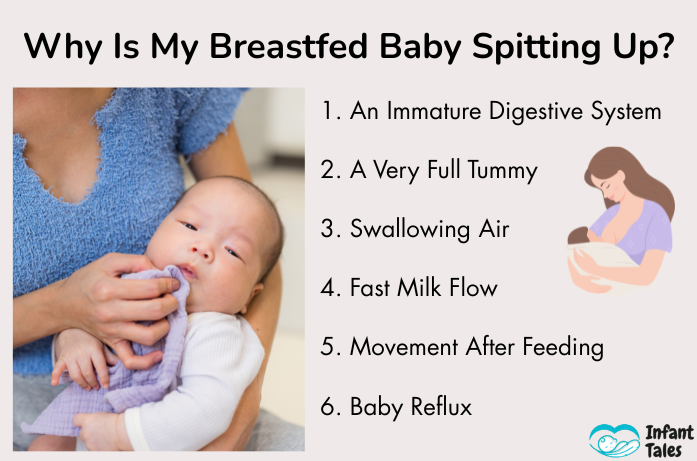
Why Is My Breastfed Baby Spitting Up?
There is rarely one single reason. Feeding speed, swallowed air, milk flow, tummy fullness, and movement after nursing can all affect breast milk spit-up.
1. An Immature Digestive System
Between the esophagus and stomach is a muscle called the lower esophageal sphincter. It works like a little doorway, opening to let milk enter and closing to keep it there.
In young babies, this muscle does not always stay tightly closed. Milk may move back upward, especially when the stomach is full. This normal movement is called gastroesophageal reflux, or GER, and it usually improves as a baby grows.
2. A Very Full Tummy
Breastfed babies usually regulate their intake well, but they may sometimes continue nursing for comfort after taking a full feed. They may also drink quickly during a strong let-down or after a longer gap between feeds.
Because a small stomach has limited space, some extra milk may come back up. If your breastfed baby spits up a lot after an eager feeding, fullness may be part of the reason.
3. Swallowing Air
Babies may swallow air when they cry before feeding, have a shallow latch, repeatedly pull off the breast, or try to keep up with fast-flowing milk. When that air rises as a burp, it can bring milk with it.
This is why spit-up often appears during burping or soon afterward. It does not automatically mean anything is wrong with your milk.
4. Fast Let-Down or Strong Milk Flow
A fast milk flow can make a baby gulp, cough, click, leak milk from the mouth, or pull away from the breast. Drinking very quickly may lead to more swallowed air and frequent spit-up.
A reclined breastfeeding position may help some babies manage the flow. Ongoing concerns about latch, milk transfer, or oversupply are best discussed with a pediatrician or qualified lactation professional.
5. Pressure or Movement After Feeding
A freshly fed tummy can be sensitive to pressure. Tight diapers, immediate tummy time, bouncing, bending at the waist, or sitting curled in a baby seat may push milk upward.
HealthyChildren.org recommends keeping the period after a feed calm and delaying active play for a little while.
6. Reflux or Another Health Concern
Ordinary reflux is common and usually does not harm a thriving baby. Gastroesophageal reflux disease, or GERD, is different because it causes troublesome symptoms or complications, such as feeding refusal, significant discomfort, breathing symptoms, or poor weight gain.
Spitting up alone does not prove that a baby has GERD. A healthcare professional will consider feeding, growth, diaper output, discomfort, and the appearance and force of the spit-up.
Why Does My Breastfed Baby Spit Up So Much?
A small amount of milk can spread widely across a bib, blanket, or shirt, making it look like an entire feed. The amount may be much smaller than it appears.
Instead of judging only by the puddle, look at your baby. Does your little one wake for feeds, swallow well, seem satisfied, have regular wet diapers, and follow an expected growth pattern? These signs are more useful than the size of one milk stain.
Kids Health explains that some babies spit up after many feeds and are still healthy. If your baby is comfortable, feeding well, having enough wet diapers, and gaining weight, it is usually normal.
Breastfed Baby Spitting Up Curdled Milk: Is It Normal?
Curdled spit-up can look alarming because it resembles cottage cheese or tiny white lumps. Usually, it means the breast milk stayed in the stomach long enough to mix with normal stomach acid and begin digesting before coming back up.
Fresh spit-up may look thin and milky, while milk that returns later can look thicker or curdled. Stomach acid is a normal and necessary part of digestion.
A breastfed baby spitting up curdled milk is generally not concerning when it is white or cream-colored, comes up without force, and your baby seems comfortable. Green, yellow-green, bloody, or coffee-ground-like vomit needs prompt medical advice.
Do Breastfed Babies Spit Up More Than Formula-Fed Babies?
Not necessarily. Both breastfed and formula-fed babies can spit up. The amount often varies more from baby to baby than it does because of milk type.
Feeding speed, swallowed air, tummy capacity, reflux tendency, bottle flow, milk let-down, positioning, and movement after eating can all make a difference. So when parents ask, “Do breastfed babies spit up more?” there is no single answer for every family.
Your baby’s comfort and growth matter more than comparisons with another child.
Spit-Up or Vomiting: What Is the Difference?
Spit-up usually flows gently, sometimes with a burp. There is little effort, and the baby often remains relaxed.
Vomiting is more forceful. You may see the tummy muscles contract, and the stomach contents may shoot outward. Repeated projectile vomiting is not ordinary spit-up and needs prompt assessment.
If something feels different from your baby’s usual pattern, note the timing, color, amount, and force. This information can help your pediatrician understand what is happening.
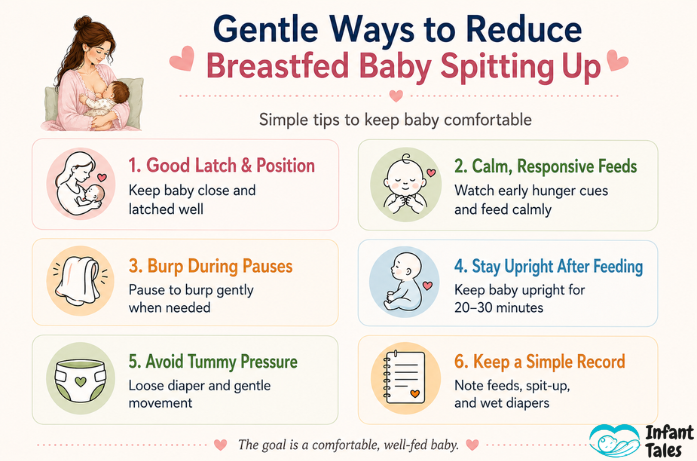
Gentle Ways to Reduce Breastfed Baby Spitting Up
You may not be able to stop spit-up completely, and that is okay. The goal is not a perfectly clean onesie; it is a comfortable, well-fed baby.
1. Check the Latch and Position
Bring your baby close, with the head and body in a straight line. A deep, comfortable latch may reduce swallowed air.
If your baby coughs or pulls away during let-down, try a laid-back position. Feeding support is especially helpful when you also have nipple pain, clicking sounds, or concerns about milk transfer.
2. Offer Calm, Responsive Feeds
Offer the breast when your baby shows early hunger cues, such as stirring, rooting, or bringing hands toward the mouth. A very hungry, crying baby may gulp quickly and swallow extra air.
Let your baby pause when needed. Responsive feeding is not a strict schedule; it is a gentle way of noticing and following your baby’s cues.
3. Burp During Natural Pauses
Not every breastfed baby needs a big burp after every feed. Still, if your baby is gulping, squirming, or changing breasts, a gentle burping pause may help.
Hold your baby upright and support the head and neck. Avoid vigorous bouncing or heavy patting, which can place pressure on a full tummy.
4. Keep Baby Upright After Feeding
Holding your baby upright for about 20 to 30 minutes may reduce spit-up. Keep the cuddle calm, without vigorous movement.
For every sleep, place your baby flat on the back on a firm, level surface. Do not raise the head of the crib or place a baby to sleep on the side or tummy because of reflux.
5. Avoid Tummy Pressure
Fasten diapers comfortably rather than tightly, and delay tummy time or energetic play until the feed has settled. When lifting your baby, avoid folding the body forward at the waist.
These small changes may not stop every milky dribble, but they can make feeds more comfortable.
6. Keep a Simple Feeding Record
Write down when feeds happen, how your baby behaves, whether the spit-up is gentle or forceful, its color, and the number of wet diapers.
The NHS notes that a feeding and symptom record can help a healthcare professional decide whether further assessment is needed.
When Should You Call the Pediatrician?
Most baby spit-up is harmless, but some symptoms need medical attention. Contact your pediatrician if your baby is not gaining weight, refuses feeds, appears unusually uncomfortable, has fewer wet diapers, or begins vomiting forcefully.
The Mayo Clinic also recommends seeking medical advice if the spit-up is green or yellow, contains blood, is accompanied by breathing problems, or changes suddenly from your baby’s normal pattern.
When Is Spitting Up an Emergency?
Get urgent medical help if your baby has:
- Green or yellow-green vomit
- Blood or coffee-ground-like material in the vomit
- Repeated projectile vomiting
- A swollen, hard, or tender tummy
- Blood in the stool
- Trouble breathing
- An inability to keep feeds down
- Noticeably fewer wet diapers
- Severe distress, unusual sleepiness, limpness, or reduced responsiveness
These are not typical signs of simple baby reflux and may indicate a serious but treatable problem. When your instincts tell you that your baby is not acting normally, seek help.
A Gentle Reminder for Worried Moms
Seeing milk come back up can make you question your supply, your feeding position, and even your ability to nourish your baby. Please remember: ordinary spit-up is not a sign that you have failed, and it does not mean your breast milk is “bad.”
Some babies are simply messier feeders while their little bodies mature. Keep a burp cloth nearby and focus on the bigger picture comfort, alertness, wet diapers, feeding, and growth.
Frequently Asked Questions
Conclusion
A breastfed baby spitting up can create plenty of worry and laundry, but in most cases it is a normal stage of infancy. Gentle spit-up after feeding, including white or curdled milk, is usually reassuring when your baby is happy, feeding well, producing wet diapers, and gaining weight.
Try calm feeds, a comfortable latch, gentle burping, upright cuddles, and less pressure on the tummy. Most importantly, trust yourself. You know your baby’s usual behavior better than anyone. When something looks forceful, unusually colored, painful, or simply not right, contact your healthcare professional.
This season will not last forever. One day, the burp cloths will disappear from every room and you may even feel a little tender remembering those milky cuddles.
Every baby is different, so trust your instincts and watch your little one’s feeding, comfort, and growth. Explore more gentle newborn care tips on Infant Tales to feel supported through every stage.
Medical Disclaimer
This article is for general educational purposes and does not replace advice, diagnosis, or treatment from your baby’s pediatrician or another qualified healthcare professional. Seek urgent medical care for serious or rapidly worsening symptoms.