Written by a caring mom at Infant Tales
Toddler sensory activities are kinda simple games that let little ones explore through touch, sight, sound, smell, movement, and body awareness. Like water pouring, playdough, bubbles, texture hunts, toy washing, pushing a laundry basket, and even dancing those are all easy examples. The best sensory play feels safe, simple, age-appropriate, and mostly led by your toddler’s own curiosity not by you.
As a mom I really love the activities that do not need some huge shopping trip or a whole hour of preparation. Toddlers can learn a ton from an old cardboard box, a bowl of water, a kitchen sponge, or just a pile of cushions, and that’s honestly enough to get started.
Also sensory play does not have to mean rice scattered across your floor! Some of the best things are low mess, using stuff already sitting around your home, so you can breathe easier.
Table of Contents
- What Are Toddler Sensory Activities?
- Why Is Sensory Play Helpful for Toddlers?
- Before You Choose an Activity, Ask: What Does My Toddler Need Right Now?
- 25 Toddler Sensory Activities That Are Actually Easy to Do
- Sensory Seeking Toddler Activities for Children Who Love to Move
- What If My Toddler Hates Messy Sensory Play?
- A Mom’s Simple Rule: Make Sensory Play Easy Enough to Repeat
- Important Sensory Play Safety Tips
- FAQs About Toddler Sensory Activities
- Final Thoughts
What Are Toddler Sensory Activities?
Sensory play gives toddlers a chance to explore the world using their senses while building important skills through hands-on experiences. Simple activities like touching different textures, playing with water, exploring sounds, and experimenting with everyday objects can support curiosity, creativity, and early development. You can also explore more ideas about how sensory play supports children’s learning and development through this helpful guide on sensory play activities for children.
When your toddler squeezes playdough, pours water, walks across grass, listens for birds, pushes a basket, or pops bubbles, several kinds of learning can happen at the same time.
Simple play can encourage movement, pretend play, problem-solving, language, and everyday skills such as pouring, scooping, carrying, and building. The American Academy of Pediatrics also encourages simple, child-led play and notes that ordinary objects such as blocks, empty containers, and wooden spoons can support children’s learning and creativity.
You do not need to turn every activity into a lesson. Sometimes, letting your child explore freely is basically enough, and it works.
Why Is Sensory Play Helpful for Toddlers?
Toddlers learn with their whole bodies. They rarely want to sit quietly while someone explains how something works. They would much rather touch it, shake it, pour it, push it, and discover what happens.
For example, transferring water between cups looks simple, but your toddler is practicing hand control, watching cause and effect, and learning words such as full, empty, wet, more, and pour.
Sensory play can also encourage pretend play. A bowl of water suddenly becomes soup. A cardboard box becomes a bus. Playdough becomes birthday cake.
These ordinary moments are one reason sensory toddler activities can fit so naturally into everyday family life.
Before You Choose an Activity, Ask: What Does My Toddler Need Right Now?
This is something many sensory activity lists do not talk about enough. Before choosing an activity, notice how your toddler is feeling at that moment.
If your little one is full of energy, climbing everywhere, or constantly moving, try activities like jumping, dancing, crawling, pushing, or carrying light objects. These can be a good way to let them use that extra energy.
If your toddler seems tired, fussy, or overwhelmed, a calmer activity may work better. Playdough, water pouring, toy washing, or a quiet sensory basket can feel more relaxing.
And if your child does not like sticky or messy textures, that is okay too. You do not need to force them to touch anything they dislike. Offer a spoon, scoop, brush, or cup so they can explore in a way that feels comfortable.
Every toddler is different, and what they enjoy can change from one day to another depending on their mood, tiredness, hunger, or surroundings.
If your child often becomes overwhelmed after busy or noisy activities, understanding the common causes of a toddler meltdown can also help you notice when they may need a calmer environment.
25 Toddler Sensory Activities That Are Actually Easy to Do
1. Water Pouring Station
Put a little water in a shallow container and add cups, spoons, and a small funnel.
Let your toddler fill, pour, empty, and repeat. Put an old towel underneath and suddenly a rainy afternoon becomes much easier to fill.
2. Frozen Toy Rescue
Freeze a few large, washable toys partly inside a container of water.
Give your toddler a cup of comfortably warm water and let them slowly “rescue” the toys as the ice melts. Talk about cold, hard, slippery, melting, and wet.
3. Playdough Bakery
Give your toddler soft playdough, a rolling pin, and large child-safe cutters.
Pretend to make cookies, pizza, or birthday cakes. Pinching, rolling, pressing, and flattening make this a lovely activity for busy little fingers.
4. Teddy Bear Washing Station
Fill a shallow bowl with water and add washable toy animals or dolls, a sponge, and a small towel.
Toddlers love copying real-life routines. Wash Teddy’s feet, scrub the toy elephant, then dry everyone off.
5. Sponge Squeeze Challenge
Place two bowls beside each other. Put water in one and leave the other empty.
Show your toddler how to soak a large sponge, carry it across, and squeeze the water into the second bowl.
It is wonderfully simple and surprisingly entertaining.
6. Edible Yogurt Painting
For a toddler who safely eats yogurt, spread a little on a clean tray and let them make swirls, lines, and handprints.
This can be a useful alternative for children who still explore everything with their mouths. Always consider your child’s allergies and usual foods first.
7. Nature Soup
Give your toddler a bowl of water outside and collect large leaves, flowers, grass, and other safe natural treasures.
Mix them together with a wooden spoon to create “garden soup.”
There is no recipe, which is exactly why toddlers love it.
8. Mystery Texture Bag
Place several large safe objects inside a pillowcase or cloth bag a wooden spoon, soft washcloth, smooth ball, sponge, or toy.
Let your toddler reach inside without looking and guess what they are touching.
Use easy words such as soft, hard, smooth, rough, and squishy.
9. Laundry Basket Delivery Game
Put a few stuffed animals or lightweight towels into a sturdy laundry basket.
Ask your toddler to push the “delivery truck” from one room to another.
This is one of my favorite sensory seeking toddler activities because it gives energetic children a real job while letting them push and use their whole body.
10. Pillow Road
Arrange firm pillows or cushions across a clear floor.
Let your toddler crawl, step, and carefully climb over them while you stay close.
Keep everything low and away from sharp furniture.
11. Animal Walk Parade
Ask, “Can you walk like a bear?”
Try frog jumps, duck walks, elephant stomps, or slow bear crawls. You will probably end up joining in and looking far sillier than your toddler.
That is part of the fun.
12. Painter’s Tape Road
Make a straight line, zigzag, or simple road on the floor using painter’s tape.
Your toddler can walk along it, drive toy cars over it, jump across it, or follow it from room to room.
13. Bubble Chase
Blow bubbles and ask your toddler to catch, clap, poke, or stomp them.
Bubbles encourage children to look, reach, move, and track something that keeps changing direction. They are also one of the easiest activities to take outdoors.
14. Push-the-Wall Game
When your energetic toddler seems determined to move every piece of furniture you own, try this instead.
Place both hands against a wall and pretend you are trying to push the whole house backwards.
Count five big pushes together.
15. Sound Detective
Sit quietly near an open window or go into the garden.
Ask, “What can you hear?”
Maybe it is a bird, fan, dog, car, footsteps, rain, or leaves moving. This simple game needs absolutely no setup.
16. Scarf Dance
Play music and give your toddler a lightweight scarf or piece of soft fabric.
Wave it high, low, fast, and slowly. Hide behind it, twirl with it, or copy each other’s movements.
17. Shadow Chase
Use natural sunlight or a safely handled flashlight to make shadows on a wall.
Move your hands, toys, or stuffed animals and watch their shadows change.
Never shine a flashlight directly into your child’s eyes.
18. Warm and Cool Washcloth Game
Prepare one comfortably warm damp washcloth and one cool damp washcloth.
Let your toddler touch each and tell you which feels warm and which feels cool.
Always test the temperature yourself first.
19. Color Treasure Hunt
Choose one color perhaps red and search the room together for red objects.
Place the objects you find in a basket, name them, and then choose another color.
This combines movement with visual matching and language.
20. Calm Sensory Bottle
Use a sturdy, completely sealed bottle containing visually interesting materials that cannot escape.
Let your toddler gently turn or shake it and watch everything move.
Inspect homemade bottles regularly and stop using them if the container or lid becomes damaged.
21. Kitchen Smell Game
Your kitchen already contains a sensory activity.
Let your toddler safely smell familiar foods such as lemon, orange peel, mint, or other foods and herbs they already encounter.
Ask simple questions: “Does it smell sweet?” or “Do you like this one?”
22. Sock Sorting Basket
Laundry day can become playtime.
Put several clean socks into a basket and let your toddler touch, match, carry, sort, and toss them.
Different fabrics and sizes add texture while matching pairs introduces a simple thinking challenge.
23. Cardboard Box Adventure
Before throwing away a large delivery box, give it to your toddler.
Today it might be a car. Tomorrow it may be a bed for stuffed animals. Five minutes later, it may simply be a box they enjoy climbing in and out of.
Simple objects often leave more room for imagination than complicated toys.
24. Garden Helper
Let your toddler dig in soil with a child-safe tool, carry a small watering can, smell herbs, collect leaves, or water plants.
Outdoor play naturally brings together sounds, smells, movement, textures, and changing sights. The AAP also highlights outdoor play as a rich source of sensory experiences for young children.
25. Painter’s Tape Toy Rescue
Lightly tape large toy animals, blocks, or cars onto a tray or other suitable surface using painter’s tape.
Invite your toddler to peel away the tape and rescue each toy.
It is low-mess, inexpensive, and perfect when you want something quick before dinner.
Sensory Seeking Toddler Activities for Children Who Love to Move
Some toddlers seem to wake up ready to climb the walls.
They jump, crash into cushions, run everywhere, push things, carry objects, spin, climb, and rarely seem interested in sitting still.
For a child like this, sensory play does not have to mean a bin of rice or foam. Whole-body activities may be far more interesting.
Try pushing a laundry basket, carrying towels, animal walks, pillow paths, bubble chasing, dancing, crawling under a table, or helping move safe lightweight objects.
Movement before a quieter activity may also help some sensory-seeking toddlers settle into seated play more easily.
At the same time, being active does not automatically mean your toddler has a sensory disorder. Toddlers naturally love movement. If sensory reactions repeatedly interfere with eating, dressing, sleep, childcare, play, or everyday family life, speak with your child’s pediatrician or a qualified professional rather than trying to diagnose the behavior at home.
What If My Toddler Hates Messy Sensory Play?
That is completely fine.
One toddler may happily cover both hands in yogurt while another looks horrified by a tiny spot of paint on one finger.
Instead of forcing contact, let your child explore using a spoon, paintbrush, sponge, toy car, scoop, or cup. You can also choose dry or no-mess activities such as sound hunts, scarf dancing, color hunts, cardboard boxes, or pushing games.
Messy play can also be a wonderful way for toddlers to experiment, create, and learn when it is introduced in a safe and comfortable way. Activities involving materials like water, sand, paint, or natural objects allow children to explore textures and practice problem-solving through play. For more guidance on creating meaningful messy play experiences for young children, parents can read this resource from Head Start: Designing Messy Play for Infants and Toddlers.
Sensory play should feel like an invitation, not a test your toddler has to pass.
If your toddler prefers creative activities with less mess, these easy toddler Christmas crafts include simple hands-on ideas using toddler-friendly materials.
A Mom’s Simple Rule: Make Sensory Play Easy Enough to Repeat
If preparing an activity takes forty minutes and cleaning it takes another forty, I probably will not do it again and I know I am not the only mom who feels that way.
Keep your setup small. Use one tray instead of covering an entire table. Put a towel underneath water activities. Take messy activities outdoors when possible.
And remember that ordinary routines count.
Bathing dolls, helping with laundry, baking together, walking barefoot on grass, digging outside, washing vegetables, playing at the park, and splashing in puddles can all offer sensory experiences.
You do not need to create a Pinterest-worthy sensory table every morning.
Important Sensory Play Safety Tips
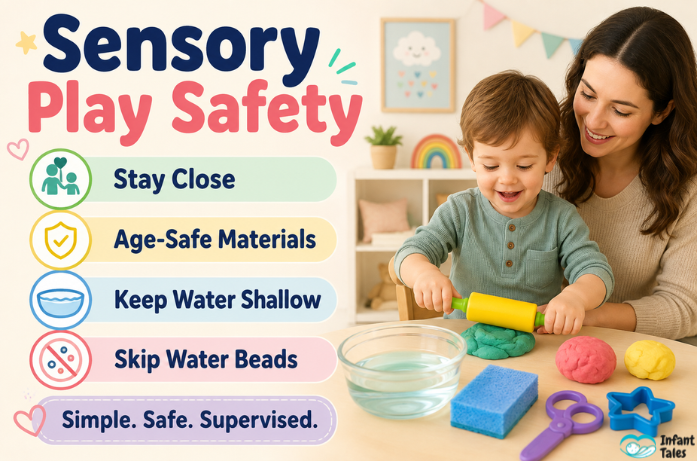
Stay close during sensory play, especially around water, food, movement activities, or anything your toddler could put into their mouth.
Choose materials based on your child’s age and habits, not only the age printed on an activity idea. If your toddler still mouths toys, avoid small sensory fillers and loose objects that could become choking hazards.
I would also skip water beads for toddler sensory play. The U.S. Consumer Product Safety Commission warns that water beads can cause serious injuries when swallowed and recommends keeping them away from young children.
Check food allergies and skin sensitivities, use washable child-appropriate materials, keep water shallow, and stop an activity if your toddler looks frightened, dizzy, distressed, or uncomfortable.
Simple and safe is always better than impressive.
FAQs About Toddler Sensory Activities
Final Thoughts
Toddler sensory activities do not need to be expensive, complicated, or perfectly planned. The best activities are often the ordinary ones that make your child stop, explore, and say, “Again!”
Maybe today that means pouring water between two cups. Tomorrow it could mean pushing a laundry basket full of teddy bears across the hallway.
Follow your toddler’s interests, keep safety in mind, and do not worry if an activity lasts three minutes instead of thirty.
Toddlerhood is already full of learning. Our job is not to turn every moment into a lesson. Sometimes we simply give them a safe place to explore, stay nearby, and enjoy watching those curious little hands discover something new.
And when you need even more inspiration beyond sensory play, these simple things to do with kids can help turn ordinary afternoons into fun family time.
Looking for more simple ways to keep your little one learning and happily engaged? Explore more toddler activities, play ideas, and parenting tips on Infant Tales.
Disclaimer
This article is for general informational purposes only and is not a substitute for professional medical or developmental advice. Always supervise your toddler during sensory play and choose activities and materials that are safe and suitable for your child’s age and abilities.
About the Author
Geeta Yogi is a parenting writer who enjoys sharing practical, low-stress ideas for toddler play, learning, and everyday development. She focuses on simple activities that encourage curiosity, movement, creativity, and meaningful parent-child interaction while keeping real family life in mind.