
Authored by: A Caring Mom at Infant Tales
Seeing your baby sticking tongue out can be adorable, but when it starts happening again and again, it is natural to wonder what it means. Your baby may do it during feeding, while playing, when teething, or simply while exploring their mouth and learning new movements.
In most cases, a baby sticking their tongue out is completely normal and is linked to feeding reflexes, hunger cues, teething, imitation, or normal development.
Babies rely on their mouths for much more than feeding. Their tongue helps them suck, swallow, explore textures, make early sounds, and respond to the world around them. So if your baby keeps sticking tongue out, the reason is often harmless.
In this guide, we’ll explain the most common reasons babies stick their tongue out, what different ages may mean, and the signs that may be worth discussing with your pediatrician.
Table of Contents
- Baby Sticking Tongue Out: Is It Normal?
- Why Do Babies Stick Their Tongue Out?
- Why Is My Baby Sticking Tongue In and Out Repeatedly?
- Does Baby Sticking Tongue Out Mean Tongue-Tie?
- Baby Keeps Sticking Tongue Out After Feeding
- When Should Parents Speak With a Pediatrician?
- What Parents Can Do at Home
- Frequently Asked Questions
- Final Thoughts
- Disclaimer
Baby Sticking Tongue Out: Is It Normal?
Yes, in most cases it is normal.
Newborns are born with feeding-related reflexes, including the tongue-thrust or extrusion reflex. This naturally causes the tongue to move forward when something touches the baby’s lips or mouth.
According to the Cleveland Clinic, tongue thrusting is common in infants and usually changes as babies grow and develop more mature eating and swallowing skills.
The reason behind the behavior can also change with age. A newborn may stick their tongue out because of feeding reflexes, while an older baby may be teething, copying you, or simply discovering what their mouth can do.
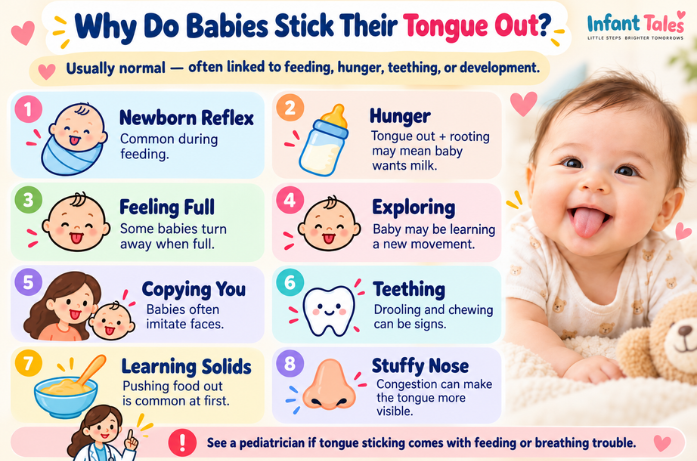
Why Do Babies Stick Their Tongue Out?
If you are wondering why do babies stick their tongue out, there isn’t just one reason.
Watching what your baby is doing before and after the tongue movement can often give you the best clue.
1. It May Be a Newborn Reflex
The tongue plays an important role in breastfeeding and bottle-feeding.
Young babies naturally move their tongue forward as part of sucking and feeding. You may notice it when your newborn is awake, searching for milk, or preparing to latch.
As your baby grows, these reflexive movements usually become more controlled.
So if your newborn occasionally shows you their tiny tongue while otherwise appearing comfortable, it is often nothing to worry about.
2. Your Baby May Be Hungry
Babies usually give several hunger signals before they start crying.
They may turn their head toward the breast or bottle, bring their hands to their mouth, open their mouth, make sucking movements, or stick their tongue out.
If the tongue appears near feeding time along with rooting and hand sucking, your little one may simply be asking for milk.
3. They May Be Full
Interestingly, tongue movements don’t always mean hunger.
A baby who has had enough may turn away, stop sucking, close their mouth, relax their hands, or push away from the breast or bottle.
That is why it helps to look at several cues together rather than deciding what your baby needs from one movement alone.
Following your baby’s hunger and fullness signals can make feeding more relaxed for both of you.
4. Your Baby Has Discovered Their Tongue
Babies spend their first year discovering new parts of their body.
First, they may become fascinated with their hands. Later come their toes, sounds, facial expressions, and yes, their tongue.
A baby sticking tongue in and out repeatedly while smiling, cooing, or playing may simply be practicing a newly discovered movement.
Babies learn through repetition, so once they discover something interesting, they often do it again and again.
There usually isn’t any need to stop them.
5. Your Baby May Be Copying You
Babies love watching faces.
They notice smiles, lip movements, voices, and expressions. As they become more socially interested, they may try to imitate what they see.
Try sticking your tongue out gently and waiting. Your baby may attempt to copy you.
These tiny back-and-forth interactions can be part of early communication and bonding.
Sometimes your little one’s tongue is simply their way of joining the conversation.
6. Teething May Be Starting
If your baby is sticking tongue out a lot and is also drooling, chewing toys, or putting their fingers into their mouth, teething may be involved.
According to the NHS, common teething signs can include increased dribbling, chewing, and sore gums.
Babies may move their tongue around because their gums and mouth suddenly feel different.
You can offer a safe, age-appropriate teething ring or other suitable teething toy.
However, don’t automatically blame significant fever, diarrhea, or illness on teething. If your baby seems unwell, speak with their healthcare provider.
7. Your Baby Is Learning to Eat Solids
Starting solid foods can make tongue movements much more noticeable.
You may lovingly prepare your baby’s first spoonful only to watch them push most of it straight back out.
Don’t worry. Your baby has spent months drinking milk, so thicker foods require completely new mouth movements.
The American Academy of Pediatrics recommends looking at overall developmental readiness for solids, such as good head control, interest in food, opening the mouth for food, and being able to move food toward the throat.
One tongue movement alone cannot tell you whether your baby is ready.
Give them time to practice, expect some mess, and keep early meals relaxed.
8. Their Nose May Be Blocked
Sometimes a baby keeps their mouth open because their nose is stuffy.
When the mouth stays open, the tongue may naturally rest farther forward and become more visible.
Temporary congestion is common, but ongoing mouth breathing or noisy breathing should be discussed with your pediatrician.
This is especially important if it affects your baby’s feeding, sleep, or comfort.
Why Is My Baby Sticking Tongue In and Out Repeatedly?
Repeated movements can look unusual, but they are often part of normal exploration.
Try noticing when the behavior happens.
If your baby sticks their tongue out before a feed and starts rooting, hunger may be the reason.
If they are chewing their fingers and drooling, teething could be involved.
If they are smiling and looking directly at you, they may simply be playing.
And if tongue movements happen during early solid-food meals, your baby may still be learning how to move food around their mouth.
The situation around the behavior usually tells you more than the tongue movement itself.
Does Baby Sticking Tongue Out Mean Tongue-Tie?
Not necessarily.
Seeing your baby’s tongue frequently does not automatically mean they have tongue-tie.
Tongue-tie, also called ankyloglossia, occurs when the tissue underneath the tongue restricts how freely it can move.
In fact, Mayo Clinic explains that some babies with tongue-tie may actually have difficulty extending their tongue beyond the lower gums.
Some may also have trouble lifting or moving the tongue from side to side.
The American Academy of Pediatrics also advises that feeding function is important when evaluating possible tongue-tie. Appearance alone does not always mean treatment is needed.
A study available through the National Institutes of Health also examined tongue-tie together with feeding history and breastfeeding experience rather than relying only on how the tongue looked.
Talk with your baby’s pediatrician or lactation professional if your baby repeatedly loses their latch, struggles to transfer milk, is not gaining weight as expected, or breastfeeding remains very painful.
Baby Keeps Sticking Tongue Out After Feeding
If your baby sticks their tongue out after a feed, it does not always mean they still want more milk.
Look at their overall behavior.
A relaxed baby with open hands and little interest in feeding again may simply be satisfied and playing.
On the other hand, a baby who continues rooting, sucking their hands, searching for the nipple, or becoming restless may still be hungry.
Wet diapers, weight gain, feeding effectiveness, and your baby’s overall behavior provide more useful information than one tongue gesture.
When Should Parents Speak With a Pediatrician?
Most tongue sticking is harmless, especially when your baby seems happy and healthy.
Still, contact your baby’s healthcare provider if tongue protrusion happens along with:
- difficulty breastfeeding or bottle-feeding
- frequent coughing or choking during feeds
- difficulty swallowing
- poor weight gain
- persistent mouth breathing
- unusual weakness or developmental concerns
- a tongue that appears unusually large or swollen
If your baby’s tongue, lips, or mouth suddenly swell or they have difficulty breathing, seek urgent medical attention.
A playful tongue movement and a baby struggling to breathe are very different situations.
A Simple Way to Understand Your Baby’s Tongue Movements
Instead of focusing only on how often your baby’s tongue comes out, look at the pattern around it. Tongue movements are easier to understand when you connect them with feeding, mood, breathing, and other changes.
When does it happen? Notice whether it appears before feeds, during teething, while playing, after eating, or throughout the day. The timing can give you an important clue about what your baby may be communicating.
How does your baby seem? A smiling, relaxed baby who is feeding and breathing normally is very different from a baby who looks uncomfortable, struggles to latch, or seems short of breath.
Is anything else changing? Pay attention to feeding, swallowing, sleep, wet diapers, weight gain, and breathing. If tongue sticking happens along with ongoing problems in any of these areas, it is a good idea to mention it to your pediatrician.
Looking at the whole picture usually gives you a much clearer answer than the tongue movement alone.
What Parents Can Do at Home
If your baby seems happy, feeds well, and is developing normally, tongue sticking usually does not need any special treatment. Instead, focus on your baby’s overall cues and comfort.
Offer feeds when your baby shows hunger signs, allow them to stop when they seem full, and enjoy plenty of face-to-face play. Talking, smiling, singing, and copying simple expressions can also support early communication.
If teething is making your baby chew more, offer a safe teething toy. When starting solids, give your baby time to learn new mouth movements without pressure. Every baby develops a little differently, so try not to compare one small habit with another child’s.
Frequently Asked Questions
Final Thoughts
Seeing your baby sticking tongue out often can seem unusual, but in most cases it is linked to normal development, hunger cues, teething, feeding reflexes, or simple exploration. If your baby is feeding well, gaining weight, breathing comfortably, and seems happy, it is usually nothing to worry about.
What matters most is your baby’s overall behavior, not the tongue movement alone. If tongue sticking comes with feeding difficulty, trouble swallowing, poor weight gain, persistent mouth breathing, or breathing problems, speak with your pediatrician.
Every baby has their own little habits, and this may simply be another cute stage that passes with time. Keep watching your baby’s cues, enjoy the funny expressions, and reach out for medical advice whenever something does not feel right.
Want more simple, mom-friendly baby care tips? Explore more helpful guides on Infant Tales and feel more confident through every little stage.
Disclaimer
This article is for general informational purposes only and is not a substitute for professional medical advice, diagnosis, or treatment. Always contact your pediatrician if you have concerns about your baby’s health or development.
About the Author
Geeta Yogi is a parenting writer who shares practical guidance about baby development, feeding cues, teething, infant milestones, and everyday baby care. Her writing focuses on helping parents understand common baby behaviors and feel more confident while supporting their little one through each stage.