Authored by: A Caring Mom at Infant Tales
Have you ever looked into your baby’s eyes and wondered what the world looks like to them? Maybe your little one spends a long time studying your face, watching a nearby toy, or staring toward the light coming through a window. Moments like these can make you curious about what your baby can actually see, especially during those first few months of life.
However, when do babies start to see colors? The babies have the ability to perceive some kind of colors at a very young age. However, their ability to recognize colors in the true sense is limited until the age of 3-4 months and at 5 months, their color vision is quite advanced.
Initially, it is easier for babies to perceive sharp contrasts, shapes and faces rather than soft colors. This happens gradually, as their eye and brain develop; they start recognizing colors. Thus, it will be surprising for you when your baby starts showing interest in colorful objects in his/her surroundings.
When Do Babies See Color?
Babies begin noticing some color very early, but their color vision is still quite limited at birth. In those first weeks, bold contrasts and bright, strongly saturated colors are usually easier for them to notice than soft or similar shades.
As the eyes and brain continue to develop, babies gradually become better at telling colors apart. By around 3 to 4 months, many babies can see a wider range of colors and shades more clearly. By about 5 months, their color vision is usually much more developed, although eyesight continues to mature as they grow.
Do Newborns Only See Black and White?
You may have heard that newborn babies can only see black, white, and gray.
That isn’t completely true.
Newborns have very limited color vision, but they are not necessarily seeing a completely black-and-white world. Some strongly saturated colors may be visible to them, although softer shades are much more difficult to distinguish.
What newborn babies respond to especially well is contrast.
For example, a bold black shape against a white background is easier for a newborn to notice than a pale pink pattern against a cream background.
This is why black-and-white books and high-contrast cards are so popular for young babies.
But don’t worry if you haven’t bought special contrast toys. Your face, clothes, windows, shadows, and everyday surroundings already give your baby plenty to look at.
What Can a Newborn Baby Actually See?
Newborn vision is blurry, and young babies see best at close distances.
During the first few weeks, your baby is especially interested in faces, movement, light, dark areas, and bold shapes.
And here’s one of those lovely little details of early babyhood: babies see best at roughly the distance between their face and yours when you’re feeding or holding them.
That means while your baby may not notice the carefully chosen nursery decorations across the room, they can spend quite a lot of time studying you.
Your eyes, your mouth, your hairline, and the movement of your face while you talk are all interesting visual experiences for your newborn.
How Does Baby Color Vision Develop?
Color vision develops as your baby’s eyes and brain learn to work together. Inside the retina are special light-sensitive cells called cones, which help the eyes detect different colors.
In newborns, these cells and the visual parts of the brain are still maturing. Research suggests that red-green color processing develops earlier, while blue-yellow processing becomes stronger a little later.
By around 3 months, babies usually have the basic systems needed to see a wider range of colors. However, their ability to notice subtle differences in shades, brightness, and detail continues improving as they grow.
According to the National Library of Medicine, a baby’s ability to notice and distinguish colors develops quickly during the first months of life.
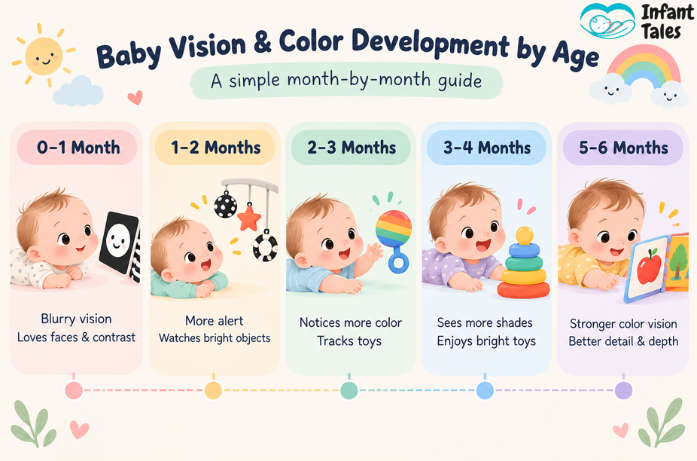
Baby Vision and Color Development by Age
Birth to 1 Month
Newborn vision is still blurry, so babies notice faces, movement, bold shapes, and strong contrast more easily than soft colors.
They may notice some bright colors, but at this stage, your face is often one of the most interesting things for them to look at.
1 to 2 Months
Around this age, babies usually become more alert and curious about what is around them.
You may notice your baby looking at your face for longer, watching a moving toy, or turning toward bright objects. Color vision is improving, but strong contrast can still be easier to notice.
2 to 3 Months
This is often when babies start paying more attention to colorful objects and toys.
If you are wondering when do babies start to see color, this stage is an important part of that development. Your baby may also begin watching moving objects more closely and showing interest in reaching toward them.
3 to 4 Months
By around 4 months, babies are usually much better at noticing different colors and shades.
Colorful books, rattles, play mats, and toys may become more interesting. You may also see your baby reaching for bright objects or studying patterns for longer.
5 to 6 Months
By around 5 months, color vision is usually much more developed.
Babies are also getting better at using their eyes together, judging distance, and noticing shapes and details. By 6 months, their visual world is much clearer, richer, and more interesting than it was during the newborn stage.
According to the American Academy of Ophthalmology, a baby’s vision continues to develop throughout the first year as focusing, tracking, color vision, and depth perception gradually improve.
What Colors Do Babies See First?
You may have heard that red is the first color babies notice. Research does suggest that some newborns may detect strong, highly saturated red more easily than certain other colors, while red-green color processing seems to develop before blue-yellow processing.
Still, babies do not all begin seeing colors in one fixed order. Things like brightness, contrast, saturation, and the size of an object can all affect what catches their attention.
So there’s no need to choose only red toys. A mix of different colors is perfectly fine as your baby’s vision continues to develop.
Why Do Babies Like High-Contrast Patterns?
High-contrast patterns are easier for young babies to notice because their vision is still developing. Bold black-and-white shapes stand out more clearly and give their eyes something simple to focus on.
As your baby grows, their vision becomes sharper and more colorful. Bright toys, books, faces, patterns, and everyday objects gradually become easier to see and much more interesting.
Color Vision and Eye Color Are Different
This is an easy thing for parents to mix up.
Color vision is your baby’s ability to see and distinguish colors.
Eye color is the visible color of the iris, such as brown, blue, gray, green, or hazel.
A baby’s eye color may change during infancy as pigment develops, but that does not affect when they begin seeing colors.
So if your newborn’s gray-blue eyes eventually turn brown, that change is separate from their developing color vision.
Simple Ways to Support Baby Vision Development
You don’t need expensive toys or special vision exercises.
Normal play and daily interaction already give your baby plenty of visual stimulation.
You can support their developing eyesight by:
- letting your baby look at your face while feeding and cuddling
- showing young babies simple high-contrast books
- slowly moving a safe toy for them to follow
- offering colorful toys and board books as they grow
- giving plenty of supervised tummy time
- letting your baby safely look at trees, leaves, clouds, and other outdoor scenery
- giving them time to study an object instead of constantly changing toys
The goal is not to make your baby develop faster.
You are simply giving their growing eyes and brain opportunities to explore.
How Can I Tell If My Baby Sees Color?
Since your baby can’t explain what they see, it can be hard to know exactly how well they notice color.
As they grow, you may see them spend more time looking at bright toys, colorful books, or other interesting objects. Still, this is not a reliable way to test color vision at home.
Instead, pay attention to their overall visual development. Looking at faces, following moving objects, watching people, and reaching for toys are all helpful signs that their vision is developing as expected.
When Should You Talk to Your Pediatrician?
Every baby develops at their own pace, so small differences in vision milestones are usually not a reason to worry. Still, it’s a good idea to speak with your pediatrician if one eye constantly turns in or out, your baby has unusual eye movements, struggles to follow moving objects, or seems very sensitive to light.
You should also mention any ongoing tearing, noticeable differences in pupil size, or if your baby rarely looks at faces or moving objects as expected for their age.
If something about your baby’s eyes or vision keeps worrying you, trust that feeling and bring it up at a checkup. Your pediatrician can take a closer look and, if needed, recommend further evaluation.
According to Nationwide Children’s Hospital, parents should discuss concerns such as poor eye alignment, difficulty tracking objects, unusual pupil differences, or ongoing sensitivity to light with their child’s healthcare provider.
Frequently Asked Questions
1. When do babies start seeing color?
Babies can detect some color very early, but newborn color vision is limited. Their ability to distinguish colors improves significantly during the first 3 to 4 months.
2. Can a 1-month-old see color?
A 1-month-old may notice some highly saturated colors, but bold contrast, faces, movement, and large shapes are generally much easier to see.
3. When do babies see in color clearly?
Color vision becomes much better between about 3 and 5 months. By around 5 months, babies generally have good color vision.
4. Do babies need black-and-white toys?
No. High-contrast toys can be easier for newborns to see, but they are not required for healthy development.
5. Does eye color affect color vision?
No. The color of your baby’s iris is separate from their ability to see colors.
Final Thoughts
Your baby’s vision changes so much during the first few months. What begins as a blurry world filled with faces, movement, and strong contrasts slowly becomes clearer, brighter, and more detailed.
By around 4 to 5 months, most babies are much better at noticing different colors and shades. Simple everyday activities like talking, reading, tummy time, and playing together give your baby plenty of natural visual stimulation.
Before long, the little one who once quietly studied your face will be reaching for bright toys, noticing patterns, and exploring everything around them with growing curiosity. It’s a beautiful change to watch.
Want more simple, mom-friendly baby development tips? Explore more helpful guides on Infant Tales and feel more confident through every little stage.
Disclaimer
This article is for general informational purposes only and is not a substitute for professional medical advice. If you have concerns about your baby’s vision or development, speak with your pediatrician or a qualified eye-care professional.