Authored by: A Caring Mom at Infant Tales
Watching your belly change can be one of the most exciting parts of pregnancy. You may find yourself checking the mirror every morning and wondering whether today is the day you will finally notice that little curve. If you are following your pregnancy bump by month, remember that every body changes differently.
For many women, a noticeable baby bump starts to appear sometime between 12 and 20 weeks, often becoming clearer during the fourth or fifth month. First-time moms may show a little later, while women who have been pregnant before sometimes notice changes sooner.
So if your belly looks smaller, bigger, higher, or lower than someone else’s at the same stage, try not to worry. Pregnancy bumps do not all grow in the same way.
Table of Contents
- When Does a Baby Bump Start Showing?
- Pregnancy Bump by Month: What You May Notice
- Why Do Some Baby Bumps Show Earlier?
- First Pregnancy vs. Second Pregnancy Bump
- Is It a Baby Bump or Just Bloating?
- When Does Your Baby Bump Start to Show Enough for Maternity Clothes?
- When Should You Talk to Your Doctor?
- FAQs About Pregnancy Bumps
- Final Thoughts
- Disclaimer
When Does a Baby Bump Start Showing?
If you are wondering when does a baby bump start showing, there is no exact week that applies to everyone.
Some women notice a small roundness near the end of the first trimester, while others do not look obviously pregnant until well into the second trimester.
Your body shape, height, abdominal muscles, previous pregnancies, and whether you are carrying one baby or multiples can all affect when your bump becomes noticeable.
That means a visible bump at 13 weeks can be normal, and barely showing at 18 weeks can also be normal.
Some women carry higher, while others carry lower. Some bumps stick straight forward, while others look wider around the waist.
Pregnancy Bump by Month: What You May Notice
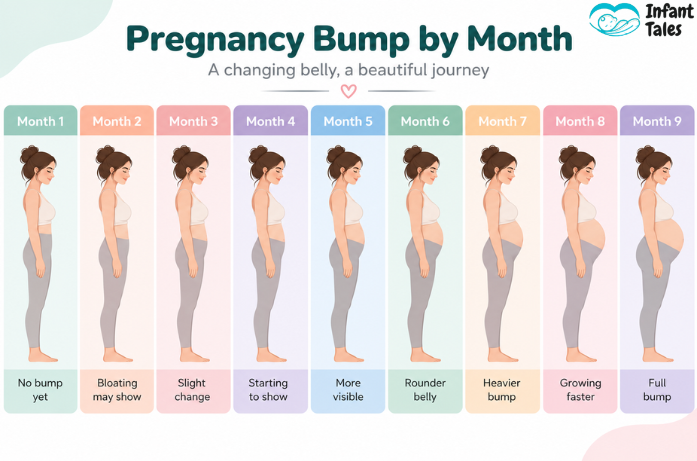
Your bump develops gradually as your uterus grows and your body adjusts to pregnancy. Here is a simple look at how your pregnancy bump by month may change.
Month 1: Usually No Visible Bump
During the first month, you normally will not have a true pregnancy bump.
Your baby is still extremely tiny, and most outward changes are caused by hormones rather than the uterus pushing outward.
You may notice breast tenderness, tiredness, mild cramping, or bloating, but your belly will usually look much the same as before pregnancy.
Month 2: Bloating Can Look Like a Bump
Around weeks 5 to 8, your clothes may begin feeling slightly tighter around the waist.
This does not always mean your baby bump is showing. Pregnancy hormones can slow digestion and cause gas and bloating, especially later in the day.
You might wake up with a fairly flat stomach and look much rounder after dinner. That early fullness is very common.
Month 3: Small Changes May Begin
During weeks 9 to 12, your lower belly may begin looking a little fuller.
Some women notice a tiny curve, while others still see almost no visible difference. First-time moms often take longer to show because their abdominal muscles have not previously stretched during pregnancy.
This is often the stage when regular jeans start feeling uncomfortable even though maternity clothes may still feel a little too big.
According to UI Health, by the third month you may notice your clothes becoming tighter around your waist as your body continues adjusting to pregnancy.
Month 4: Your Bump May Become Noticeable
Around weeks 13 to 16, many moms finally begin seeing a more obvious pregnancy shape.
Your belly may stay rounder throughout the day rather than changing mainly because of bloating.
If you have been wondering when does baby bump start to show, this is often when the difference becomes easier to notice.
Some women will already have a clear bump, while others may only have a gentle curve. Both can be completely normal.
Month 5: The Bump Often Becomes More Obvious
Between weeks 17 and 20, pregnancy usually becomes easier to see from the outside.
Your uterus continues expanding, and your bump may become higher and rounder. Around this time, many first-time moms also begin noticing the first tiny movements from their baby.
The American Pregnancy Association also notes that around the fifth month, many moms begin feeling their baby’s movements as growth and development continue.
This is often when maternity clothes become much more comfortable than regular jeans and fitted tops.
Month 6: Your Belly Gets Rounder
During weeks 21 to 24, your bump will usually look noticeably pregnant.
Your baby is growing, but remember that your belly contains more than your baby. The uterus, placenta, amniotic fluid, and other pregnancy changes all contribute to its size.
You may also notice stronger movements and kicks as your baby becomes more active.
Month 7: Your Bump Feels Heavier
By weeks 25 to 28, your bump may begin to feel much more noticeable during everyday activities.
Bending down, putting on shoes, or getting out of bed can suddenly require a little more effort.
Baby movements may feel stronger too, and you may notice rolls, stretches, and kicks throughout the day.
At this stage, the pregnancy often starts to feel very real physically as well as emotionally.
Month 8: Your Belly May Grow Quickly
During weeks 29 to 32, your baby continues gaining weight and your uterus takes up more space.
You may feel more pressure around your ribs, pelvis, or lower back, and getting comfortable at night can become harder.
Your bump may also look different depending on your baby’s position. Some days it can seem round, while other days one side may look slightly more prominent.
Month 9: Your Full Pregnancy Bump
In the final weeks, your belly will usually be at its largest.
Your bump may look high, low, round, or wide. As your baby prepares for birth, you might notice your belly appearing lower, although this does not happen the same way for every woman.
By now, you have probably become very familiar with every kick and stretch. After months of watching your belly grow, it can feel amazing to realize you will soon meet the little person inside.
Why Do Some Baby Bumps Show Earlier?
If you are asking when does your bump start showing compared with other moms, several normal factors can make a difference.
Previous Pregnancies
Women who have already been pregnant may notice their bump earlier.
The abdominal muscles and tissues have stretched before, so the belly can sometimes become noticeable sooner during a second or later pregnancy.
Body Shape
Height, torso length, body composition, and muscle tone can affect how your bump looks.
Someone with a shorter torso may appear to show sooner, while a taller woman with a longer torso may have more room for the uterus to grow upward.
Twins or Multiples
If you are carrying twins or more than one baby, your uterus may grow faster and your bump may become noticeable earlier.
Your healthcare provider will monitor a multiple pregnancy more closely based on your individual needs.
First Pregnancy vs. Second Pregnancy Bump
A first pregnancy and a second pregnancy can look surprisingly different.
During your first pregnancy, your abdominal muscles are tighter and have not stretched around a growing uterus before. Because of this, your bump may take longer to become noticeable.
With a second or later pregnancy, you may see changes earlier.
This does not mean your baby is necessarily larger. It simply means your body has been through pregnancy before and may respond differently this time.
Is It a Baby Bump or Just Bloating?
Early pregnancy bloating can be very convincing.
Bloating often changes throughout the day. Your belly may look smaller in the morning and fuller after meals or by evening.
A real pregnancy bump tends to become more consistent as your uterus grows.
During the early weeks, it is very common for bloating to make you feel much more pregnant than you actually look. Eventually, the temporary fullness slowly turns into a bump that stays around all day.
Why Does My Bump Look Different From Other Moms?
Pregnancy bumps can look so different from one mom to another, even at the exact same week. One belly may sit high and round, while another may look lower, wider, or more forward.
So many little things can shape the way your bump looks, including your height, body shape, muscle tone, previous pregnancies, your baby’s position, and even how much amniotic fluid you have.
It is easy to compare your belly with photos online, but those pictures rarely tell the full story. Your bump does not need to look like anyone else’s to be healthy or normal.
When Does Your Baby Bump Start to Show Enough for Maternity Clothes?
There is no specific week when you should start wearing maternity clothing.
Some women switch to stretchy clothes during the first trimester because bloating makes regular jeans uncomfortable. Others wear their normal clothes well into the second trimester.
Start whenever you need more room.
Stretchy leggings, loose dresses, elastic-waist trousers, longer tops, and waistband extenders can make the transition easier before you want to buy a full maternity wardrobe.
Comfort matters much more than waiting for your bump to reach a certain size.
Simple Ways to Enjoy Your Growing Bump
Your changing belly can become one of the sweetest records of pregnancy.
If you enjoy taking photos, try taking one bump picture each month in the same place. You do not need matching clothes, a perfect background, or professional lighting.
You could also write one little memory beside each photo.
Maybe it was the month you felt the first flutter, bought your first maternity dress, heard the heartbeat, or felt your baby kick strongly for the first time.
Those little memories often become more special later than the perfectly posed pictures.
When Should You Talk to Your Doctor?
Having a smaller or later-showing bump does not automatically mean something is wrong.
Your prenatal visits are far more useful than comparing your belly with someone else’s. Your doctor or midwife can monitor your baby’s growth properly and recommend additional checks if needed.
Contact your healthcare provider if you are worried about growth, have pain, bleeding, leaking fluid, unusual swelling, or notice a change in your baby’s usual movements later in pregnancy.
It is always okay to ask questions when something does not feel right.
FAQs About Pregnancy Bumps
Final Thoughts
If you are wondering when does a baby bump start showing, remember that many women begin noticing a clearer bump during the second trimester, but there is a wide range of normal.
Following your pregnancy bump by month can be a lovely way to enjoy the changes happening in your body, but try not to compare your belly with someone else’s. Your bump may appear earlier, later, smaller, larger, higher, or lower, and still be completely healthy.
One day that tiny curve will become a round belly full of kicks and wiggles, and before you know it, the baby you have been carrying will be in your arms. Let your body grow in its own way.
Want more simple pregnancy tips and month-by-month guidance? Explore Infant Tales for warm, practical support through every stage of your pregnancy journey.
Disclaimer
This article is for general informational purposes only and does not replace personalized prenatal care or medical advice. Speak with your doctor, midwife, or qualified healthcare professional if you have concerns about your pregnancy or your baby’s growth.
About the Author
Geeta Yogi is a parenting writer who shares warm, practical guidance about pregnancy, baby development, maternal wellness, and everyday parenting. Her writing focuses on helping expecting moms understand normal pregnancy changes, enjoy important milestones, and feel more confident throughout each stage of their journey.