By a Caring Mom at Infant Tales
Counting is one of the first “big kid” steps in the early education of a kid. And kids don’t learn numbers just by looking at worksheets, they learn through movement, laughter, touch, exploring, and repeating. This is the reason why counting games for kindergarten are considered one of the most effective ways by parents and teachers to develop good math skills in the early years of school.
By turning counting into a fun adventure, kids get a more natural understanding of numbers and they forget them less. If a child is learning to count from 1 to 10, discovering kindergarten counting games 1 to 20, or just adding, these entertaining activities help the child gain confidence while enjoying learning at the same time.
The early math specialists from reliable institutions like Erikson Institute’s Early Math Project and NAEYC (National Association for the Education of Young Children) have said that practical number activities create more profound comprehension than mere memorization. This is what along with the 15 counting games, your kindergartener will truly like to engage with this guide, the fun, meaningful, and developmentally appropriate ones.
Why Play-Based Counting Matters in Kindergarten
Kids in kindergarten are very active and learning through play due to that is the most effective way because their brains are set for exploring, being curious, and moving. Playing with numbers activates different senses which facilitates the children to remember the concept for a longer time. If a kid plays with blocks, jumps on nums, classifies objects, or constructs with one hand, he/she is creating mental “hooks” that make math to be concrete, not abstract.
Play-based learning supports:
- Strong number recognition
- One-to-one pairing
- Basic knowledge of addition and subtraction
- Development of spatial skills
- Awareness of patterns
- Logical thinking
- Confidence and independence
Playful math has been pointed out as one of the crucial ingredients for academic success by research-supported websites like PBS. The amazing thing is that you do not have to have any special tools. Using simple instructions and regular household items may yield the best results.
Let’s explore 15 fun and developmentally appropriate kindergarten math counting games that you and your child will surely enjoy, and that will help your child on their early learning journey.
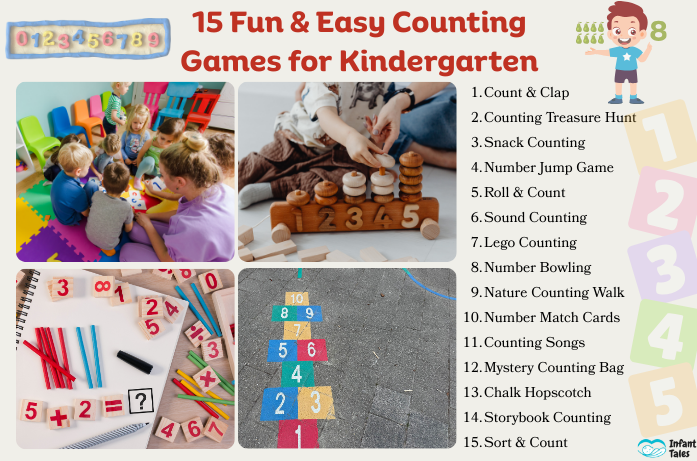
15 Fun & Easy Counting Games for Kindergarten
1. Count & Clap Rhythm Game
Movement is what very young children like most. This easy-going rhythm game around counting transforms learning into a full-body experience.
Voice a number, for example, 5, and your kid claps 5 times to equal it. Then when the game is on, you can move to stomping, tapping, or snapping. This gives your child the idea of auditory counting, bodily coordination, and number recognition all at once.
The particular game is very much apt for kids who have a hard time with one-to-one correspondence because it shows them to link a sound to a count.
2. Treasure Hunt Counting Challenge
This type of activity characterized by adventure works no less perfectly in classrooms than in homes. Ask your child: “Find 7 soft things,” “Bring me 3 round objects,” or “Collect 10 leaves.” Children’s imagination is allowed to run wild while they count, sort, and compare the objects, besides, they learn the math vocabulary.
Once they become confident, you can change it into a counting game up to 20 by increasing the number challenge.
3. Snack Counting Fun
Food is always a good way to grab attention. Before kids are allowed to eat, give your child a small bunch of snacks, such as fruit slices or crackers, and then ask them to count how many they have on their plate.
You can even go a little further; after you have added two more pieces, ask, “How many now?” Children begin to grasp the concept of addition very early.
4. Number Line Jumping Game
With the help of tape, chalk, or paper, draw a number line from 1 to 10 or from 1 to 20 on the floor. Have your little one pick a number and hop on it. After that, have them bounce two spots forward, or one back, bringing early arithmetic into the picture with movement.
Among the best engaging number exercises for kindergarteners is the physical activity since the kids can actually feel the distance of the numbers.
5. Dice Roll Counting Race
Dice games are quick for kids to learn the numbers. So, take the dice, and ask your kid to count the dots after rolling. Then, start a competition to check who will be the first to reach 20 on a drawn scoreboard.
This practice is a good way to develop subitizing, which is the ability to recognize small quantities at once, a basic math skill that is imparted through playing number activities for kindergarten.
6. Sound Counting Game
It is a calm, straightforward, and yet very effective method to train listening skills. Make some noise on a table or with a bell a couple of times. Your child has to listen carefully and then say how many bangs they heard. This is a good practice for children with difficulties in concentration, attention, or auditory processing.
Sound counting is also a good way to enhance one’s short-term memory.
7. Lego Counting Towers
Children are always happy to build, so Lego activities are a great way to introduce math to young students. Tell your child to build a tower with 10 blocks, then another with only 7. Finally, ask, “Which one is taller?” or “Which one has fewer blocks?”
This exercise promotes number comparison, sequencing, and spatial comprehension that are all vital counting activities for kindergarteners.
8. Indoor Bowling with Numbers
Plastic cups can easily be used as bowling pins. Just remember to write a number on each cup. Your child can knock down the pins, but then they have to figure out the numbers and count the ones they hit.
This activity not only helps with counting and recognizing numbers but also with basic addition. It is a great fun indoor activity that kids love to repeat whenever it rains outside.
9. Nature Walk Counting
Let your child enjoy a nature walk outside. Have them pick up sticks, leaves, pebbles, or flowers one by one and count them. If your child is ready, separate them by type or size and then count each group.
This counting game is one of the most fun activities for children because it connects learning with nature and sharpens their sensory skills.
10. Number Card Matching
Using index cards, write numbers on them, then give your child a pile of small objects. Your child must place the correct number of objects next to each card.
This simple yet effective activity enables one-to-one correspondence and reinforces visual number recognition; both are essential skills in kindergarten.
11. Counting Songs & Music Games
Songs help children memorize numbers effortlessly. Nursery rhymes like “Five Little Ducks” or “Ten in the Bed” help children understand number order and the concept of counting backwards. Pause the song and ask: “What comes next?” or “What number is missing?”
Music has a profound effect on memory; therefore, it’s great for beginning math learners.
12. Mystery Number Bag
Put little items in a fabric bag. Your kid is allowed to take out items without peeking and counting them. The mysterious aspect makes the activity thrilling, and kids doing without sight alone.
This also leads to boosting sensory learning, guessing, and inquisitiveness.
13. Sidewalk Chalk Hopscotch Counting
Create a hopscotch grid with numbers. Each time your child jumps, say a number out loud. Hopscotch is great for number sequencing because children engage in physical activity while counting.
You can make this a counting game for kindergarteners 1–20 by creating a longer hopscotch trail with more numbers.
14. Counting in Storybooks
While reading, involve your kid in counting different objects on the pages, for example, stars, animals, toys, or leaves. This practice not only enhances the child’s concentration on the details but also allows them to notice mathematics in their daily life.
Counting while sharing stories also brings about language development, understanding, and visual thinking as well.
15. Sorting & Counting Challenge
Sorting is one of the most effective math activities for preschoolers. Provide a mixture of items, such as buttons, beads, and blocks, and tell your little one to organize them in terms of size, color, or shape. Count the number of items in each group after sorting.
This way of teaching introduces comparison, organization, and basic data-handling skills to the children in a soft and playful manner.
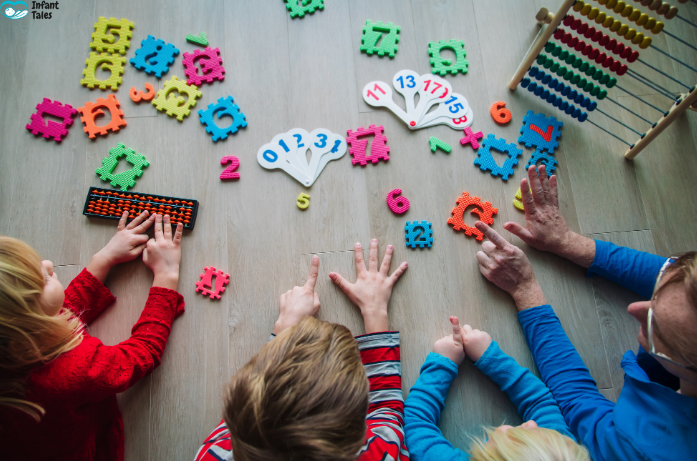
How to Make Counting Easier for Young Learners
Children learn best when the process is fun, informal, and stress-free. They can only tolerate short sessions because young children’s brains tire quickly. Always set games for 5 to 15 minutes, depending on your child’s mood.
Let your little one use all their senses touching, jumping, moving, building, and exploring, these are the key elements of early math. Perfection isn’t the key, but consistency is. Repeated play will build stronger memory connections.
Your child will sometimes make mistakes, forget numbers, or count the same number twice. This is an important part of the process. The imprinting and resilience that comes from sweat will be very helpful.
When to Seek Professional Guidance
All children have different learning speeds. Nevertheless, if a child is of the age 5-6 years and still has difficulty in:
- identifying the most basic numbers
- correctly counting small groups
- grasping the concept of quantity
- maintaining attention in simple number games
…it would probably be beneficial to talk to your child’s teacher or an early childhood expert. The CDC Child Development guidelines can help you understand the expected milestones more clearly.
This content is for educational purposes only and is not a substitute for a medical assessment.
Final Thoughts
Playing with numbers helps children to gain confidence that will last even until they get their math books. The counting games designed for kindergarten children present maths in the most usual way, that is, through fun, imagination, and tactile discovery.
Instructional activities such as sorting leaves, jumping on number lines, and making Lego towers are just some kids-friendly activities that will support their early math skills development.
Frequently Asked Questions
1. How can I teach counting from 1–20 naturally?
Use counting games for kindergarten 1–20 such as hopscotch, number hunts, Lego towers, and dice games. Movement and objects make counting 1–20 easier and more enjoyable.
2. What are the best counting games for kids at home?
Treasure hunts, snack counting, nature walks, and clap-count games are excellent choices because they can easily be integrated into daily life and they require no special tools.
3. What is the recommended frequency of practicing counting with my child?
Daily brief practices, 10 minutes at most, are much more effective than long lessons. When there is repetition and play involved, children learn best.
Keep reading Infant Tales for more parenting tips, early learning ideas, and simple activities.