Authored by: A Caring Mom at Infant Tales
There comes a stage when your toddler suddenly decides naps are no longer part of the plan. You close the curtains, read the usual book, give a cuddle, and five minutes later you hear little feet moving around again.
This is where quiet time for toddlers can become such a helpful part of the day.
Quiet time does not mean your child has to sit perfectly still or stay completely silent. It is simply a slower part of the day when busy little bodies can take a break from running, climbing, talking, and exploring.
And yes, it can give parents a small moment to recharge too.
Table of Contents
Quiet Time for Toddlers: What Does It Mean?
Quiet time is a gentle break in the day when your toddler can slow down and enjoy calm, low-energy play.
They might flip through a favorite book, cuddle a stuffed animal, draw with crayons, work on a simple puzzle, or listen to a story. There is no need for them to stay completely still or silent.
It can be especially useful when naps start becoming inconsistent. Maybe your toddler naps one day but refuses the next, spends nap time chatting to toys, or takes a late nap that makes bedtime difficult. Nemours Kids Health notes that toddlers still need plenty of total sleep, including naps for many children.
However, quiet time does not automatically mean your child is ready to stop napping. Many two-year-olds still need daytime sleep. If your toddler becomes very tired, emotional, or overwhelmed later in the day without a nap, they may still need one.
If quiet time happens around the usual nap hour, keep the approach relaxed. Let your child know they can rest or play quietly, and if they fall asleep, that is perfectly fine too.
Before worrying too much about schedules and timing, here are some simple quiet time activities you can try at home.
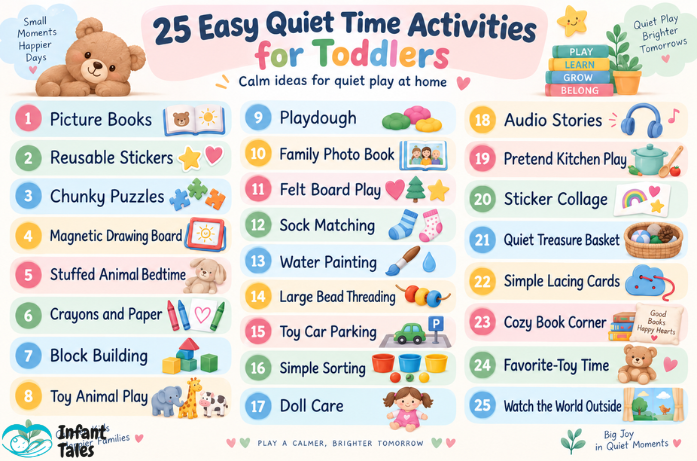
25 Easy Quiet Time Activities for Toddlers
The best activities are usually simple, safe, and easy enough for your child to enjoy without needing constant instructions.
You also do not need to buy lots of special toys. Many of these ideas use things you probably already have at home.
1. Picture Books
Place a few favorite books in a small basket.
Your toddler can turn the pages, point to familiar objects, name animals, or simply enjoy looking at the pictures.
2. Reusable Stickers
Reusable sticker books are great for little hands.
Animal, farm, vehicle, or nature scenes can keep toddlers interested while encouraging simple imaginative play.
3. Chunky Puzzles
Large wooden puzzles are useful quiet activities for toddlers.
Choose familiar themes such as animals, shapes, fruit, or vehicles so your child can easily recognize the pictures.
4. Magnetic Drawing Board
A magnetic drawing board lets your child scribble, erase, and start again.
It is simple, quiet, and much less messy than paints or markers.
5. Stuffed Animal Bedtime
Give your toddler a stuffed animal and a small blanket.
They can rock it, feed it, tuck it into bed, or pretend to read it a story.
6. Crayons and Paper
Offer a large sheet of paper and a few chunky crayons.
At this age, there is no need to expect proper drawings. Scribbles, dots, and lines are part of the fun.
7. Block Building
Put a small number of blocks in a basket rather than offering the whole collection.
Your toddler may build towers, make roads, or simply arrange the blocks in rows.
8. Toy Animal Play
Give your child a few toy animals and allow them to create their own little world.
They may make a farm, zoo, animal family, or bedtime scene.
9. Playdough
Playdough is lovely for squeezing, rolling, flattening, and shaping.
Keep the activity simple and supervise younger toddlers who may still put things into their mouths.
10. Family Photo Book
Create a small album with pictures of parents, grandparents, siblings, pets, and familiar places.
Toddlers often enjoy looking at people they recognize and naming them.
11. Felt Board Play
Felt animals, shapes, or simple characters can be moved around again and again.
It gives toddlers something creative to do without lots of noise or mess.
12. Sock Matching
Place a few pairs of clean socks in a basket.
Your toddler can match pairs, sort colors, or simply move them from one basket to another.
13. Water Painting
Give your toddler a paintbrush and a small amount of water.
They can “paint” cardboard, a chalkboard, or outdoor paving and watch the marks slowly disappear.
14. Large Bead Threading
Older toddlers may enjoy threading large, age-appropriate beads onto a thick cord.
Avoid small beads or pieces that may become choking hazards.
15. Toy Car Parking
Draw simple parking spaces on a piece of cardboard.
Your toddler can drive toy cars around and park them in different spaces.
16. Simple Sorting
Use blocks, toy animals, large cups, or other safe objects.
Your child can sort them by color, type, or size without needing to get everything correct.
17. Doll Care
Give your toddler a doll, blanket, cup, or brush.
They can copy familiar routines such as feeding, cuddling, brushing hair, or putting the doll to sleep.
18. Audio Stories
Some children find total silence uncomfortable.
A gentle children’s story or audiobook can provide background company while your toddler looks at books or plays quietly.
19. Pretend Kitchen Play
A few bowls, cups, wooden spoons, and toy foods can inspire plenty of imaginative play.
It is also a simple answer when you are wondering how to keep 2 year olds busy without automatically turning on a screen.
20. Sticker Collage
Give your toddler a sheet of large stickers and a piece of paper.
Let them stick everything wherever they want without worrying about making a perfect picture.
21. Quiet Treasure Basket
Fill a basket with a few safe objects of different textures.
A soft cloth, wooden spoon, silicone cup, chunky brush, or other toddler-safe household items can work well.
22. Simple Lacing Cards
Older toddlers may enjoy pushing a thick lace through large holes.
They do not need to complete the whole card. Even a few attempts can keep little hands busy.
23. Cozy Book Corner
Place a few cushions, favorite books, and a stuffed toy in a quiet corner.
Sometimes changing the setting makes an ordinary activity feel new again.
24. Favorite-Toy Time
Offer two or three familiar toys and let your toddler choose how to play with them.
Independent play does not always need a planned activity.
25. Watch the World Outside
A window can sometimes be surprisingly entertaining.
Your toddler may watch birds, cars, trees moving in the wind, or people walking past. You can even leave a couple of books or soft toys nearby.
Quiet Activities for Preschoolers
As toddlers move into the preschool years, they can usually manage slightly more detailed activities.
Good quiet activities for preschoolers include coloring books, beginner puzzles, matching games, reusable activity books, simple crafts, building sets, pretend play, and audiobooks.
You can also create a small activity tray with three choices and let your child decide what they would like to do first.
A little choice can make quiet time feel less like something they “have to do.”
How Long Should Quiet Time Be?
There is no perfect amount of time.
If your child is not used to independent play, start with around 10 minutes. Once that feels comfortable, you can gradually increase it to 15 or 20 minutes.
Some children may eventually enjoy 30 to 45 minutes.
Try not to focus too much on reaching a particular number. A calm 20-minute routine that works well is better than forcing an hour that leaves everyone frustrated.
Create a Simple Quiet-Time Space
You do not need a beautiful playroom or a special quiet-time corner.
A bedroom, playroom, living room rug, or cozy corner with a small basket of activities can work perfectly well.
Put away noisy toys and offer only a few choices at a time. Too many options can sometimes make it harder for young children to settle into one activity.
If your toddler will be playing independently, make sure the area is properly childproofed. Secure furniture, remove accessible cords, and keep small choking hazards out of reach.
Make a Quiet-Time Basket
A quiet-time basket can make the routine easier for both you and your toddler.
Fill it with four or five calm activities such as books, reusable stickers, a small puzzle, a drawing board, or a favorite stuffed animal.
Try keeping the basket only for quiet time.
Every few days, swap one or two items for something different. You do not need to buy anything new. Toys that have been put away for a week can suddenly feel exciting again.
What If My Toddler Won’t Stay Alone?
Not every toddler is ready to play independently in another room, and that is okay.
Start with quiet time together.
Sit nearby while your child plays and do something calm yourself, such as reading, folding laundry, or having a cup of tea.
Once your toddler becomes comfortable with the routine, you can gradually move farther away or briefly leave the room before returning.
Independent play usually develops little by little rather than overnight.
Try Busy First, Quiet Second
Some toddlers simply need to move before they can slow down. Healthy Children also encourages calm, predictable routines when helping young children settle down.
If your child has lots of energy, try a short walk, outdoor play, dancing, or kicking a ball before quiet time.
Afterwards, have lunch, offer some water, read a short book together, and then move into calmer play.
This can make the transition feel much more natural than asking an energetic toddler to suddenly sit quietly.
Keep Quiet Time Positive
Try not to use quiet time as punishment after a tantrum, shouting, or difficult behavior. According to the CDC, time-out is a specific behavior-management strategy used as a consequence for certain behaviors, so it is helpful to keep everyday quiet time separate from discipline.
Keeping quiet time separate from time-out can help your toddler understand that this part of the day is for calm play and rest, rather than something that happens when they are in trouble.
It also does not have to be completely silent.
Your toddler may sing, talk to toys, move around, or tell an entire story to a stuffed animal. As long as the play is safe and reasonably calm, the routine is still doing its job.
Frequently Asked Questions About Toddler Quiet Time
Final Thoughts
Quiet time can become a lovely little pause in an otherwise busy toddler day.
Some days your child may happily look through books or play alone for a while, while other days they may want you close by. Both are completely normal.
Keep the routine simple, choose activities your toddler genuinely enjoys, and allow quiet time to develop at their own pace.
Over time, these calm moments can help your child become more comfortable with independent play while giving the whole family a chance to slow down and reset.
There is no need for quiet time to look perfect. A few peaceful minutes in the middle of a busy day can be valuable all on their own.
Looking for more simple ways to make parenting easier? Explore helpful toddler activities, practical parenting tips, and everyday ideas on Infant Tales.
About the Author
Geeta Yogi is a parenting writer who shares practical guidance about toddler routines, independent play, sleep transitions, and everyday family life. Her writing focuses on helping parents create simple, calm routines that support young children while making busy days feel a little more manageable.